
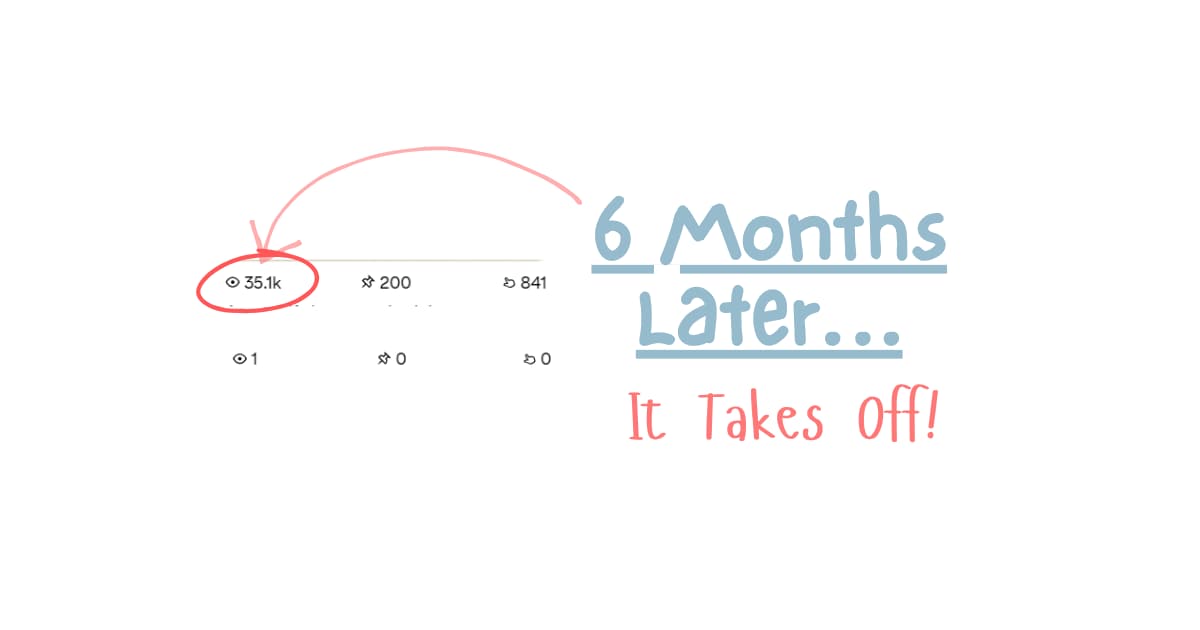
Have you ever published a Pinterest pin, waited for traffic to come in, and felt disappointed when almost nobody clicked it?
You might think the pin isn’t working. Maybe the design isn’t good enough, the topic isn’t popular, or Pinterest simply isn’t showing your content to the right people.
But then, six months later, something unexpected happens.
That same pin starts getting impressions, attracting clicks, and sending traffic to your website. Suddenly, a pin you almost forgot about becomes one of your biggest traffic drivers.
I’ve seen this happen with my own Pinterest content, and it’s one of the reasons I don’t judge a pin by its first few days of performance.
So, why do some Pinterest pins go viral months after they’re published? Is Pinterest completely random, or is there a reason certain pins take off long after they go live?
From what I’ve observed, several things can explain this delayed growth, including Pinterest’s ongoing learning process, changing audience interests, seasonal demand, and the way your content library develops over time.
In this article, I’ll break down why old Pinterest pins can suddenly take off, what I’ve learned from publishing pins, and why I believe patience and consistency matter so much when you’re growing a website with Pinterest.
Why Do Some Pinterest Pins Go Viral Months Later?
Some Pinterest pins take off months after publication because the audience, timing, and information Pinterest has about that content can change over time.
When I publish a new pin, I don’t expect it to become a traffic winner immediately. Pinterest still needs opportunities to understand what the pin is about, how people respond to it, and which audiences might find it useful.
At the same time, people’s interests are constantly changing. A topic that attracts little attention today might become much more relevant in a few months. Seasonal content is a good example of this.
Imagine publishing a Halloween pin in April. Even if the content is excellent, there might not be much demand for it at that moment. Fast-forward to September, when people start looking for Halloween recipes, decorations, costumes, and party ideas, and that same pin suddenly has a much larger potential audience.
The pin hasn’t changed. The timing and demand have.
That’s the biggest thing I’ve learned about Pinterest: a pin’s early performance doesn’t necessarily tell you how well it will perform in the long run.
Let’s look at the reasons behind this in more detail.
1. Pinterest Is Different From Instagram
One of the biggest mistakes I see people make is treating Pinterest like Instagram.
On Instagram, much of a post’s reach tends to happen shortly after publication. If a post doesn’t perform well during that initial period, it can feel like the opportunity has passed.
Pinterest works differently.
A pin you publish today might continue attracting traffic next month, next year, or even several years from now. This is why I see Pinterest as a long-term platform rather than a place where every piece of content needs to succeed immediately.
Think about the difference.
When you publish a new pin, you’re not necessarily creating something that has only a few days to generate results. You’re adding another piece of content to your Pinterest library, where it may continue finding relevant audiences over time.
This changes how I approach Pinterest marketing.
Instead of asking, “Why isn’t this pin getting clicks today?” I try to think about its longer-term potential.
Could the topic become more relevant later? Could Pinterest find a better audience for it? Could demand for the subject increase during a particular season?
You can’t know exactly what will happen with every pin.
And that’s precisely why I don’t think it’s a good idea to dismiss a pin simply because it didn’t perform well during its first few days.
Pinterest isn’t only about what people want to see right now. It’s also about matching content with what people are looking for at the right moment.
2. Pinterest Needs Time to Understand Your Pins
Here’s something worth remembering whenever you publish a new Pinterest pin: Pinterest doesn’t immediately know how useful that pin will be to people.
When a pin goes live, there isn’t yet a long history of interactions showing how people might respond to it.
Will people stop scrolling when they see it? Will they click through to your website? Will they save it for later? Will the content satisfy the people who visit it?
Those are the kinds of questions I believe Pinterest can learn more about as people interact with a pin.
Think of it this way.
You publish a pin for a blog post about Labrador training. Pinterest has the new content, but it still needs opportunities to learn more about how people respond to it.
Over time, interactions may provide more information about the audience that finds the pin useful.
That process doesn’t necessarily happen overnight.
A pin might receive limited attention initially, then gradually reach more people as Pinterest gathers more information about how it performs.
I can’t predict exactly when this will happen with any individual pin, and not every pin will eventually take off.
But this is one reason I avoid making quick judgments about new content.
Sometimes, a pin simply needs more time to find its audience.
3. Pinterest Learns From How People Interact With Your Content
Another reason I believe some Pinterest pins gain traction later is that their performance can develop as people interact with them.
From my observations after publishing Pinterest content, I think of Pinterest as a recommendation system that’s continuously learning rather than one that makes a single decision about a pin.
Imagine publishing a pin that initially reaches a relatively small audience.
Pinterest can observe what happens next. Do people stop scrolling? Do they click? Do they save the pin for later?
When those interactions are positive, it makes sense that Pinterest may become more confident about recommending the pin to additional users.
The process can continue over time as more people encounter the content.
Of course, I can’t see every decision Pinterest makes behind the scenes, so I don’t treat this as a guaranteed explanation for every viral pin. It’s simply how I understand the patterns I’ve observed.
The important thing is that a pin’s performance can evolve after publication.
A slow start doesn’t automatically mean the content has no potential.
This is also why I don’t expect every pin to follow the same timeline. Some might gain attention relatively quickly, while others may take much longer to find the right audience.
If you judge all your Pinterest content by its initial results, you could overlook pins that still have room to grow.
4. Seasonal Demand Can Bring Old Pinterest Pins Back to Life
Seasonal demand is one of the easiest ways to understand why an old Pinterest pin might suddenly start performing well.
Let’s say you publish a Halloween blog post in April.
You create a pin for it, publish it on Pinterest, and wait for traffic.
But nothing much happens.
You might start wondering whether the pin design is the problem or whether the article simply isn’t interesting enough.
Then September arrives.
People begin looking for Halloween party ideas, costumes, recipes, and decorations. The topic becomes more relevant, and your existing pin has the opportunity to reach people who are now interested in that content.
Suddenly, the pin starts getting attention.
Notice what changed: the content itself didn’t need to change for its relevance to increase.
The demand changed.
This is why I think it’s important to understand the timing behind your Pinterest topics.
A pin can be published when relatively few people are interested in a subject and become much more valuable when that interest increases later.
And this doesn’t only apply to Halloween.
The broader lesson is that audience demand can change over time. A topic that doesn’t attract much attention at one point may become far more relevant at another.
So, when a seasonal pin isn’t performing as expected, I wouldn’t automatically assume it’s a failure.
It might simply have been published before the audience was ready for it.
5. Your Audience Can Change Over Time
Seasonality isn’t the only reason older Pinterest pins can suddenly find new life.
People’s interests change every day, and new audiences continually develop interests that may match content you’ve already published.
Think about it.
Someone gets a new puppy and starts looking for training advice.
Someone moves into a new apartment and begins searching for decorating ideas.
Someone decides to start meal prepping and needs recipes.
Someone wants to remodel their kitchen and starts collecting inspiration.
Yesterday, these people might not have been interested in your content. Today, they might be looking for exactly what you’ve already created.
Your pin doesn’t necessarily need to be new to be relevant to them.
This is one of the reasons I find Pinterest interesting as a traffic source. Your existing content can continue reaching people whose interests develop after you publish it.
You might have written an article months ago that wasn’t attracting much attention. Later, a new group of people becomes interested in the topic, creating another opportunity for that content to be discovered.
You can’t predict every change in audience interest, and you can’t guarantee that every old pin will eventually find a larger audience.
But you also can’t assume that the people who ignored your pin when it was published will be the only people who ever see it.
New interests create new opportunities for existing content.
That’s a big reason I prefer building a growing content library instead of focusing all my attention on the immediate results of individual pins.
6. Publishing More Content Can Help Pinterest Understand Your Website
There’s another part of Pinterest marketing that I think is easy to overlook: the relationship between your individual pins and the broader collection of content on your website.
Imagine you publish one article about Labrador training.
Then you publish another.
And another.
Over time, your website develops a larger collection of related content.
From my perspective, this gives Pinterest more context about the topics your website covers and the type of content you create.
Rather than having just one article about a subject, you now have multiple pieces of content that help describe your website’s focus.
That doesn’t mean publishing one article automatically causes another article to rank or receive more impressions. I wouldn’t make that assumption.
But as your website grows, the overall collection of content may give Pinterest a clearer picture of your areas of focus, which could help it make more relevant recommendations.
This is one reason I like thinking about Pinterest as a long-term content strategy.
You’re not just creating individual pins and hoping each one succeeds on its own. You’re building a library of content around the subjects your website covers.
Every new article and pin becomes another opportunity for people to discover your work.
And as that library grows, you have more content that may become relevant to different audiences at different times.
7. Why I Don’t Judge a Pinterest Pin After One Week
If there’s one habit I’d encourage you to rethink, it’s judging your Pinterest content too quickly.
I’ve seen how easy it is to publish a pin, check the results, and immediately feel disappointed.
Maybe it only gets a handful of clicks.
Maybe the impressions are lower than you expected.
Maybe another pin you published around the same time performs much better.
It’s tempting to conclude that the weaker pin isn’t worth your attention anymore.
But I don’t think one week is enough time to decide whether every Pinterest pin has potential.
Some pins need time for Pinterest to learn more about them. Others may be published before demand for their topics increases. And some might simply need to reach a more relevant audience.
You don’t always know which explanation applies.
More importantly, you don’t know which pin might surprise you several months later.
I’ve seen pins that initially attracted very little traffic become much bigger traffic drivers later. Those experiences have changed the way I think about early performance.
Instead of treating every slow pin as a failure, I see it as one piece of a much larger content strategy.
That doesn’t mean every pin will eventually become successful. Some will perform well, some will perform modestly, and others might never attract the traffic you hoped for.
The point is that you can’t identify every future winner from its first few days of results.
So, before deciding that a pin has failed, remember that Pinterest content can have a much longer life than you might expect.
8. Why Consistency Matters More Than Individual Pins
Here’s where all these ideas come together.
If Pinterest can continue recommending older content, audience interests can change, and seasonal demand can increase months after publication, then it makes sense to keep building your content library.
I don’t approach Pinterest with the expectation that every pin I publish will become a winner.
Instead, I focus on creating more opportunities.
Some pins might perform reasonably well. A few might perform exceptionally well. Others might surprise me months later.
That’s normal when you’re working with a growing collection of content.
Imagine building a library of hundreds of pins and hundreds of articles.
Each one represents another piece of content that could become relevant to someone in the future.
You don’t know exactly which pin will attract the most traffic, how long it will take, or when its topic might become more popular.
But if you stop publishing because a few recent pins didn’t perform well, you’re also stopping yourself from creating new opportunities.
This is why consistency matters so much to me.
I’m not treating every pin like a lottery ticket that either wins or loses immediately. I’m building a collection of content that can continue generating traffic over time.
The more content I create, the more opportunities I have for Pinterest users to discover my website.
And because I can’t predict which pin will become my next traffic winner, I don’t want to rely entirely on the performance of a handful of posts.
I’d rather keep building a library of useful content and give those pieces opportunities to find their audiences.
That’s the long-term mindset I believe Pinterest requires.
How Long Does It Take for a Pinterest Pin to Go Viral?
There’s no single timeline I can give you for every Pinterest pin.
Some pins might start attracting attention relatively quickly. Others may take weeks or months to gain traction. And some might continue generating traffic much later.
The same pin can also experience different levels of demand over time.
For example, a seasonal pin might receive little attention when you publish it months before the relevant season. As that season approaches, more people become interested in the topic, creating an opportunity for the pin to reach a larger audience.
Another pin might gradually find people who are newly interested in its subject.
And in other cases, Pinterest may have more information about how people interact with your content as time passes.
These are possible explanations for delayed growth, not guarantees that every pin will eventually go viral.
My biggest takeaway is simple: don’t assume a pin has failed just because it hasn’t performed well during its first week.
Give yourself room to look at the bigger picture rather than expecting every piece of content to produce immediate results.
What Should You Do When a Pinterest Pin Isn’t Getting Traffic?
When a pin isn’t attracting the traffic you expected, I think the first step is to avoid panicking.
It’s easy to feel discouraged when you put time into creating content and don’t see immediate results. But an early lack of traffic doesn’t automatically tell you everything you need to know about a pin’s future performance.
Here are the main lessons I take from my experience with Pinterest.
1. Don’t rush to delete underperforming pins
If a pin isn’t performing well right away, I wouldn’t automatically assume it’s worthless.
It might need more time to reach the right audience, or its topic might become more relevant later.
That doesn’t mean every pin should be kept forever regardless of its performance. It simply means early results alone aren’t enough to predict every pin’s long-term potential.
2. Think about when your topic becomes relevant
Consider whether the subject of your pin has a seasonal element.
A Halloween pin published in April, for example, may have a different audience opportunity in September when people begin planning for the season.
The timing of demand can influence how much interest a topic receives at a particular moment.
3. Keep publishing consistently
Don’t let a few disappointing pins convince you to stop creating content.
Every new pin gives you another opportunity to connect with people who are interested in your topics.
Some content will perform better than others, and you won’t always know which pieces will become your biggest traffic drivers.
That’s why I prefer to keep building my content library instead of relying on immediate results from individual pins.
4. Look at Pinterest as a long-term traffic strategy
One of the biggest mindset shifts is recognizing that Pinterest content doesn’t have to deliver all its results immediately.
An older pin can still find new audiences, become relevant during a different season, or attract attention as people’s interests change.
When you understand that possibility, it’s easier to avoid making decisions based only on short-term performance.
Ultimately, the goal isn’t to force every pin to go viral.
It’s to keep creating content that has the potential to reach the right people over time.
Why do Pinterest pins get traffic months after being published?
Pinterest pins can gain traffic months later for several reasons. Audience interests change, seasonal demand increases, and Pinterest may learn more about how people interact with a pin over time.
A pin that initially attracts little attention may eventually become relevant to a larger audience. However, this doesn’t mean every pin will eventually go viral.
Can an old Pinterest pin go viral?
Yes, an older Pinterest pin can suddenly gain traction long after publication.
For example, a Halloween pin published in April might become more relevant in September when people begin searching for seasonal ideas.
The content doesn’t necessarily need to change for its potential audience to change.
Should I delete Pinterest pins that aren’t getting clicks?
I wouldn’t automatically delete a pin just because it isn’t getting clicks during its first few days or weeks.
Some pins take longer to find their audiences, and others may become more relevant when interest in their topics increases.
Early performance doesn’t always reveal a pin’s long-term potential.
How long should I wait before judging a Pinterest pin?
I avoid judging a pin after just one week because Pinterest content can gain traction over a much longer period.
There isn’t one timeline that applies to every pin. Some gain attention quickly, while others may take months to become meaningful traffic drivers.
The important thing is to avoid assuming that a slow start guarantees poor long-term performance.
Why do seasonal Pinterest pins suddenly get more impressions?
Seasonal pins can become more relevant as the related season approaches and people begin looking for ideas connected to it.
A Halloween pin, for example, may receive limited attention in April but find a larger potential audience in September.
The change in demand can create a new opportunity for existing content.
Does publishing more Pinterest content help?
Publishing more content creates a larger library of pins and articles that people may discover over time.
As your website develops related content, Pinterest may also gain more context about the topics your website covers.
However, publishing more content doesn’t guarantee that every pin will perform well or that one article will automatically cause another to rank.
Why is consistency important for Pinterest traffic?
Consistency matters because you can’t predict which pin will become a major traffic driver or when that might happen.
By continuing to publish, you’re creating more opportunities for Pinterest users to discover your content now or in the future.
Some pins will perform better than others, and some may surprise you months after publication.
That’s why I prefer to focus on building a growing content library rather than judging my entire Pinterest strategy by a few individual pins.
Final Thoughts
If there’s one thing I’ve learned about Pinterest, it’s that you shouldn’t expect every pin to become successful immediately.
Pinterest content can have a much longer life than you might expect. A pin that attracts very little attention today could become one of your biggest traffic drivers months later.
Sometimes, the topic becomes more relevant as seasonal demand increases. Sometimes, new audiences develop interests that match your existing content. And sometimes, Pinterest may learn more about how people interact with a pin over time.
You can’t predict exactly which pin will take off or when it will happen.
And that’s precisely why I don’t want to judge my entire Pinterest strategy by the performance of individual pins during their first few days.
Instead, I focus on consistency and building a growing library of content.
Every article I publish and every pin I create gives my website another opportunity to reach people who are interested in what I share.
Some pins will perform better than others. Some might never attract the traffic I hoped for. But others may surprise me months later.
So, if your Pinterest pins aren’t getting many clicks right now, don’t automatically assume your efforts are wasted.
Give your content time, keep building your library, and remember that today’s quiet pin could become tomorrow’s traffic winner.
The biggest lesson? Don’t just create pins for today’s traffic. Build a Pinterest content library that can continue working for you months and even years from now.