
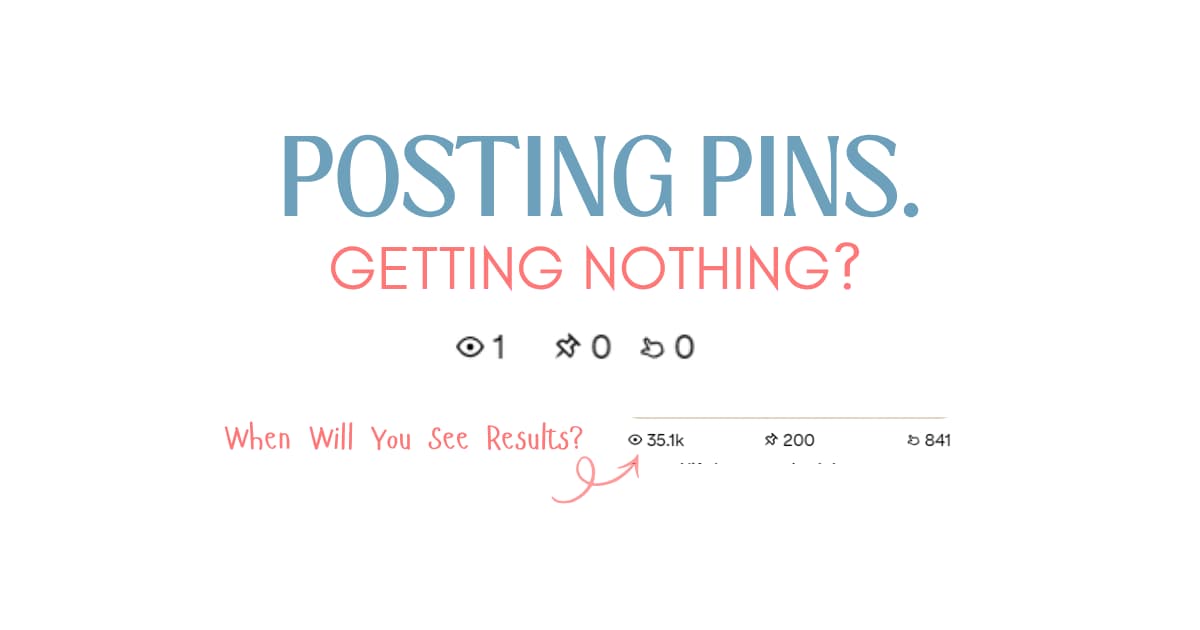
If Pinterest feels painfully slow right now, I get it. You’re publishing blog posts, designing pins, researching keywords, and trying to do everything right…. but your analytics barely move.
Five impressions here. Twenty impressions there. Maybe one click if you’re lucky.
And suddenly, you start wondering: Am I doing something wrong? Is my SEO bad? Should I change my strategy?
I’ve been through this frustrating stage myself, and here’s what I want you to understand: Pinterest can take time to gain momentum, especially when you’re starting with a brand-new website.
I recently started a new site with a completely fresh domain, no existing audience, no Pinterest history, and no domain authority. For the first few weeks, it honestly felt like nothing was happening.
Then, almost overnight, impressions started climbing. Clicks followed, and I was using the same content and the same strategy.
So, what changed?
Pinterest simply started gaining more confidence in my content.
Once I understood why Pinterest growth can feel so slow at first, it became much easier to be patient and focus on what actually matters instead of constantly questioning everything I was doing.
In this article, I’ll explain why Pinterest takes time to grow, why your pins might get almost no impressions initially, what to focus on while waiting for results, and when it might be time to fix something in your strategy.
Why Is Pinterest SO Slow at First?
The biggest reason Pinterest feels so slow at first is that publishing content doesn’t automatically mean Pinterest is ready to show it to thousands of people.
I think many people start using Pinterest expecting results similar to TikTok. You publish something today, and you want to see views tomorrow.
But that’s not how I approach Pinterest.
Pinterest is much closer to Google than it is to Instagram. It needs to understand your content before it starts distributing your pins to a larger audience.
Your pins don’t necessarily take off simply because you uploaded them. They grow as Pinterest gradually gains confidence in your content.
And this is where things get frustrating.
You can spend hours writing helpful blog posts, designing beautiful pins, optimizing your content for keywords, and doing everything you believe you should be doing.
Yet when you open your analytics, the numbers barely move.
It’s tempting to assume your strategy isn’t working.
But low impressions during the first few weeks don’t automatically mean your content is bad or that Pinterest is rejecting your pins.
Sometimes, you’re simply at the beginning of the process.
That’s exactly what happened with my newest website. It started from zero, and for weeks, it looked like nothing was working.
If I had judged the entire strategy based on those first few weeks, I would have assumed it had failed.
But I didn’t have enough information to make that decision yet.
The lesson? Don’t confuse slow growth with no potential for growth.
Why Pinterest Growth Doesn’t Happen Overnight
To understand why Pinterest takes time, you need to think about what Pinterest is trying to do.
Millions of new pins are uploaded every day. Pinterest can’t automatically know which new pins deserve to receive more traffic.
So, rather than immediately showing every new pin to a huge audience, it starts small.
Your content might receive a few impressions here and there. Pinterest gradually tests how people respond to it.
When people engage with your content, Pinterest may widen its audience. If they don’t, it may try showing the content somewhere else.
This is why Pinterest growth often looks more like a staircase than a straight line.
You might see very little activity for weeks, followed by a noticeable increase in impressions and clicks.
And once you experience that first increase, you start to understand why patience matters so much.
Pinterest needs time to test your content
When you publish a new article and create pins for it, you can’t expect immediate traffic just because you’ve optimized everything.
Pinterest still needs time to understand the content and test how it performs.
During this stage, your analytics might look disappointing.
You might publish consistently and still wonder whether anyone is seeing your work.
But remember, the initial testing stage is not necessarily a sign that something is wrong.
It’s part of the process of giving new content a chance to find its audience.
Pinterest growth is rarely a straight line
One of the biggest mistakes I see is expecting Pinterest impressions to increase steadily every single day.
That’s not always how it works.
You might have a period where nothing seems to change, followed by a sudden increase in impressions.
Then, as Pinterest gains more confidence in your content, you may start seeing more consistent activity.
This is why I wouldn’t judge my Pinterest strategy based on a few days of analytics.
The bigger picture matters much more than what happens on one particular day.
What Happens When You Publish a New Pin?
When you’re starting a new Pinterest account or sending traffic to a brand-new website, it’s easy to assume that every pin should start generating impressions almost immediately.
But I don’t look at it that way.
Think about the process in stages.
Stage 1: You publish your content
You write your blog post, optimize it, create your pins, and publish them.
At this point, you’ve done the work on your side.
However, publishing your content doesn’t guarantee immediate distribution.
Stage 2: Pinterest starts testing your pins
Your pins may begin receiving small amounts of exposure.
You might see five impressions, twenty impressions, or another number that feels almost insignificant.
This is usually the stage where beginners start panicking.
They wonder whether their keywords are wrong, their designs aren’t good enough, or their website has some major problem.
But low initial impressions alone don’t tell you that.
Pinterest may simply be in the early stages of testing your content.
Stage 3: Pinterest gathers more information
As people interact with your pins, Pinterest has more information about how the content performs.
If people engage, Pinterest may expand the audience.
If they don’t, it may try a different audience.
This process is one reason why some pins take longer than others to gain traction.
Stage 4: Your content starts gaining momentum
Eventually, some pins may begin receiving more impressions and clicks.
And here’s something interesting: the pin that starts driving traffic might not be the one you published yesterday.
It could be a pin you’ve almost forgotten about.
This is why I wouldn’t give up on a strategy simply because the first few weeks feel quiet.
You need to give your content enough time to move through the process.
Why Your Pinterest Impressions Are So Low at First
If your Pinterest impressions are barely moving, there are a few things I would consider before assuming your strategy has failed.
1. You’re starting with a brand-new website
A new website doesn’t have the same history as an established website.
When I started my newest site, it had no existing audience, no Pinterest history, and no domain authority.
In other words, I was starting from zero.
For the first few weeks, the results were so limited that it would have been easy to conclude that nothing was working.
But that experience reminded me not to judge a new website too quickly.
If you’re in the same situation, give yourself enough time to see how your content develops before deciding that your strategy isn’t working.
2. You’re expecting clicks before impressions increase
When you start using Pinterest, it’s natural to focus on clicks.
After all, you want people to visit your website.
But if your content is barely receiving impressions, you shouldn’t expect a steady stream of clicks either.
At this stage, I pay much more attention to impressions because they help me understand whether Pinterest has started testing my content.
Clicks usually come later.
If your impressions are gradually increasing, that’s a positive sign worth paying attention to, even if your traffic isn’t where you want it to be yet.
3. You’re judging your strategy too early
Two weeks can feel like a very long time when you’re putting in effort and seeing almost nothing in return.
But making major decisions based on such a short period can be a mistake.
I’ve seen how easy it is to become impatient, start questioning every decision, and feel tempted to change everything.
The problem is that you might interrupt the process before Pinterest has had enough time to gather information about your content.
Instead of constantly changing your strategy, give it time to develop and monitor the progress you’re actually seeing.
4. You’re expecting every pin to perform immediately
Not every pin will gain traction at the same time.
Some might receive very few impressions initially, while others may start gaining attention much later.
This is why I wouldn’t assume a pin has failed simply because it doesn’t perform well during its first few days or weeks.
Sometimes, the content you least expect to perform becomes one of your biggest traffic drivers later.
And that’s something worth remembering when you’re tempted to delete everything that isn’t getting immediate results.
Why Your Old Pins Can Suddenly Start Getting Traffic
Have you ever noticed that one of your best-performing pins isn’t necessarily the one you published yesterday?
This is one of the most interesting things about Pinterest.
I’ve had pins that did almost nothing for months, only to become some of the biggest traffic drivers on an account later.
The pin didn’t suddenly become a completely different piece of content.
It was the same pin, but the timing was different.
This is another reason why Pinterest can feel confusing when you’re just starting.
You might spend hours creating new pins and wonder why they aren’t getting results, while an older pin you’ve completely forgotten about suddenly starts receiving impressions and clicks.
It reminds me that I can’t always predict which pin will perform best or exactly when a pin will start gaining traction.
And if you delete pins or constantly change your approach because the initial numbers look disappointing, you might be making decisions before you have a complete picture of their potential.
Should you give up on pins that aren’t performing?
I wouldn’t automatically give up on a pin simply because it hasn’t performed well in the beginning.
Low initial impressions don’t necessarily mean the pin will never receive traffic.
At the same time, patience doesn’t mean ignoring every possible problem forever.
The important thing is to give your content a reasonable opportunity to develop while continuing to pay attention to your SEO, keywords, and pin quality.
Don’t assume every underperforming pin is a failure, but don’t use patience as an excuse to ignore problems either.
How Pinterest Momentum Makes Growth Easier
Here’s another reason Pinterest can feel painfully slow in the beginning: things may become easier once your account starts gaining momentum.
When Pinterest begins trusting your account and content more, new pins may rank faster.
This helps explain why the beginning can feel so difficult, while several months later, you might notice that your content is gaining traction more easily.
You’re not necessarily creating dramatically better pins than you were before.
Pinterest may simply have more confidence in your content.
Think about my new website again.
At first, the results were almost nonexistent. I had no established audience or Pinterest history to build on.
Then impressions started climbing, followed by clicks.
I was still using the same content and strategy, but the results were beginning to change.
That’s why I don’t think it’s helpful to judge your entire Pinterest journey based on what happens during the earliest stage.
Your first few weeks don’t necessarily represent what your account will look like several months later.
Sometimes, the hardest part isn’t getting Pinterest traffic. It’s getting through the period before that traffic starts to build.
Impressions vs. Clicks: What Should You Track First?
If you’re constantly refreshing your Pinterest analytics to check whether you’ve received more clicks, I want you to reconsider what you’re focusing on.
When I’m in the early stages of growing a Pinterest account, I care much more about impressions than clicks.
Why?
Because impressions help me see whether Pinterest is starting to test my content.
Clicks are important, of course. The goal is to bring people to your website, not just collect impressions.
But clicks usually come later, and expecting them too early can make you feel as though your strategy isn’t working when it might simply need more time.
Here’s how I think about these two metrics when starting out.
| Metric | What I pay attention to |
| Impressions | Is Pinterest beginning to show my content to people? |
| Clicks | Is my content starting to bring people to my website? |
If your impressions are slowly rising, that’s a good sign to monitor.
You might not see many clicks yet, but the fact that your content is receiving more exposure gives you something more meaningful to evaluate than checking whether you’ve gained a click every few hours.
Instead of obsessing over your analytics throughout the day, look at the overall direction your account is moving in.
Are impressions gradually increasing? Are some pins beginning to receive more attention? Is your content starting to gain momentum?
These are the kinds of questions I would ask before deciding whether my strategy needs a major change.
What to Do While Waiting for Pinterest Traffic
Now, let’s talk about something important.
Being patient doesn’t mean doing nothing.
I don’t believe you should simply publish a few pins, sit back, and wait indefinitely for Pinterest to bring you traffic.
You still have work to do while your content develops.
The difference is that you don’t need to change your entire strategy every time your analytics disappoint you.
Here are the areas I would continue focusing on.
1. Keep publishing consistently
One of the biggest differences between people who eventually gain traction and those who don’t is that some people quit before giving their content enough time to develop.
You can spend weeks publishing articles and creating pins, see very little progress, and start wondering whether it’s worth continuing.
But if you stop publishing every time growth feels slow, you’re not giving your strategy much opportunity to develop.
Keep creating content instead of assuming that the lack of immediate results means your efforts are pointless.
Consistency gives you more opportunities to build on what you’re already doing.
2. Continue improving your blog posts
Your articles are an important part of your Pinterest strategy.
While waiting for traffic, continue improving your content rather than focusing exclusively on your analytics.
Look at the articles you’re publishing and consider where you can make them better.
You don’t have to assume everything you’ve created is perfect, but you also don’t need to rewrite your entire website just because Pinterest hasn’t started sending you consistent traffic.
Keep improving your articles while giving your existing content time to perform.
3. Create more pins
Continue creating pins for your content instead of letting your frustration stop your publishing process.
Remember, some pins may take longer to gain traction than others.
You might not immediately know which pin will become one of your biggest traffic drivers, so don’t assume every new pin needs to produce results right away.
Keep creating, publishing, and observing how your content performs over time.
4. Cover more keywords
Keyword optimization is another area I would continue working on while waiting for results.
If you’re already creating content, don’t abandon your keyword strategy simply because impressions are low during the first few weeks.
Continue covering relevant keywords as part of your content creation process.
And if your account has been consistently flat for several months, your keywords are one of the areas worth reviewing alongside your SEO and pin quality.
5. Don’t change everything every few weeks
This is probably one of the most important lessons I would share with anyone starting on Pinterest.
When results are slow, it’s tempting to redesign your pins, delete existing content, change keywords, switch niches, or even start an entirely different website.
I understand why people do this.
You want to see progress, and when you don’t, you naturally look for something you can change.
But if you keep restarting the process every couple of weeks, you might never give Pinterest enough time to gather information about your content.
Instead, focus on publishing, improving your articles, creating pins, and covering more keywords.
Make changes when you have a reason to make them, not simply because you’re frustrated with the numbers.
How Long Should You Wait Before Changing Your Pinterest Strategy?
This is where I think it’s important to find a balance between patience and taking action.
I’m not saying you should ignore your Pinterest analytics forever or keep doing the exact same thing regardless of the results.
There is a difference between a new account that has been active for two weeks and an account that has been publishing consistently for several months without any improvement.
After two weeks: Don’t panic
If you’ve only been publishing for two weeks and your impressions are still low, I wouldn’t immediately assume that something is wrong.
Your content may still be in the early testing stage.
At this point, I would focus on continuing to publish and giving Pinterest more time to understand your content.
Avoid making dramatic changes simply because you haven’t seen the results you hoped for.
After one month: Keep looking at the bigger picture
One month can feel like forever when your analytics barely move.
But a month of slow results doesn’t automatically prove that your strategy has failed.
If you’re starting with a brand-new website, remember that your account doesn’t have an established Pinterest history to build on.
Continue publishing, improving your articles, creating pins, and covering more keywords.
Pay attention to the direction your impressions are moving rather than expecting immediate traffic.
After several months: Investigate possible problems
This is where I would start looking more closely at the strategy.
If you’ve been publishing consistently for several months, your impressions are still completely flat, and you’ve already checked your SEO, keywords, and pin quality, then something probably needs fixing.
Patience doesn’t mean refusing to make improvements.
It means understanding when slow growth might be part of the process and when a lack of progress deserves a closer look.
The goal isn’t to keep waiting forever. It’s to avoid abandoning a strategy before you’ve given it a fair chance.
Signs Your Pinterest Strategy Might Need Fixing
So, how do you know when you’re simply being impatient and when you should investigate your strategy?
I would start by looking at the length of time you’ve been publishing consistently and the areas you’ve already reviewed.
Here are the main things I’d consider.
Your account is still very new. If you’ve only been publishing for a couple of weeks, low impressions alone aren’t enough for me to conclude that the strategy has failed.
Your impressions are slowly increasing. Even if clicks are still limited, rising impressions suggest Pinterest is beginning to show your content to people. I’d keep monitoring that progress.
Your impressions have been completely flat for several months. This is when I’d investigate further, particularly if you’ve been publishing consistently.
You haven’t reviewed your SEO, keywords, or pin quality. Before deciding that Pinterest simply isn’t working for you, make sure you’ve checked these areas.
I wouldn’t recommend blindly waiting for results, but I also wouldn’t recommend changing everything every time you experience a quiet period.
Look at the situation as a whole.
A new website with low impressions needs a different response from a website that has been publishing consistently for several months without any movement.
The Biggest Mistake New Pinterest Marketers Make
If I had to point to one mistake that makes Pinterest growth even more frustrating, it would be quitting too early.
I don’t think the biggest problem is always bad SEO or unattractive pins.
Sometimes, it’s that people don’t give their strategy enough time to work.
They publish content for two weeks, see almost no impressions, and start making drastic changes.
They redesign everything. They delete pins. They change keywords. They switch niches or start another website.
Then the process starts all over again.
The problem is that they might never give Pinterest enough time to collect information about the content they’re already publishing.
Imagine working hard on your blog posts and pins, only to abandon the strategy before you have a meaningful opportunity to see how they perform.
That’s why I think patience is such an important part of growing on Pinterest.
You don’t have to be the most talented person creating pins.
You don’t have to get everything perfect from the beginning.
But you do need to be willing to continue working while your results are still developing.
The people who make progress aren’t necessarily the ones who never experience slow growth. They’re often the ones who keep publishing while everyone else has already quit.
And if you’re currently in that frustrating stage where it feels like nobody is seeing your content, don’t automatically assume you’ve failed.
You might simply be earlier in the process than you think.
Frequently Asked Questions About Slow Pinterest Growth
Why is Pinterest so slow at first?
Pinterest can feel slow at first because new content needs time to be understood and tested. Your pins may initially receive only a small number of impressions as Pinterest gathers information about how people respond to them.
This is especially frustrating when you’re starting a brand-new website without an existing audience or Pinterest history.
Why are my Pinterest impressions so low?
Low Pinterest impressions can happen during the early stages of publishing new content. Pinterest may initially show your pins to a small audience before deciding whether to expand their reach.
However, if you’ve been publishing consistently for several months and your impressions remain completely flat, review your SEO, keywords, and pin quality.
How long does it take to get traffic from Pinterest?
There isn’t a specific timeline in the information I’ve seen from my own experience that applies to every website.
My newest website had very little activity during its first few weeks before impressions started climbing and clicks followed.
The important thing is not to assume that a lack of immediate traffic means your strategy has failed.
Should I delete Pinterest pins that aren’t getting impressions?
I wouldn’t automatically delete a pin simply because it isn’t performing well initially.
I’ve had pins that did almost nothing for months before becoming some of the biggest traffic drivers on an account.
A pin’s early performance doesn’t always tell you how it will perform later.
Should I focus on Pinterest impressions or clicks first?
When I’m starting out, I pay more attention to impressions.
Impressions help me understand whether Pinterest has started testing my content, while clicks show whether people are visiting my website.
Both matter, but impressions can be a more useful early indicator when you’re still waiting for your content to gain traction.
Why do my old Pinterest pins suddenly get traffic?
I’ve seen pins that performed poorly for months suddenly become major traffic drivers.
Sometimes, an older pin starts gaining attention much later than expected. The pin itself hasn’t necessarily changed; the timing has.
This is one reason I wouldn’t assume that a pin has no potential simply because it didn’t perform well when it was first published.
Should I change my Pinterest strategy after two weeks?
I wouldn’t make drastic changes based only on two weeks of low impressions.
Instead, continue publishing, improving your articles, creating pins, and covering more keywords.
If you’ve been publishing consistently for several months and impressions remain completely flat, that’s a better reason to investigate your SEO, keywords, and pin quality.
Does Pinterest get easier over time?
In my experience, growth can feel easier once an account begins gaining momentum.
As Pinterest gains more confidence in your content, new pins may rank faster.
That doesn’t mean every pin will perform well, but it helps explain why the beginning can feel much harder than later stages of growth.
Final Thoughts: Be Patient With Pinterest
If there’s one thing I want you to take away from this article, it’s this: Pinterest growth can be slow at first, and that doesn’t automatically mean you’re doing something wrong.
I’ve experienced what it’s like to start a brand-new website, publish content, create pins, and wait while the analytics barely move.
For weeks, my newest site looked almost dead.
Then impressions started climbing, and clicks followed.
The content and strategy hadn’t suddenly changed. Pinterest was beginning to gain more confidence in the content I was publishing.
That’s why I don’t think you should judge your entire Pinterest strategy based on the first two weeks or even the first month.
Keep publishing consistently. Improve your articles. Create more pins. Cover more keywords. Pay attention to your impressions instead of obsessing over clicks every few hours.
And remember that patience doesn’t mean ignoring problems forever. If you’ve been publishing consistently for several months and your impressions remain completely flat, review your SEO, keywords, and pin quality.
But if you’re just starting out and wondering why nobody seems to be seeing your content, give yourself a little breathing room.
You might not be failing. You might simply be in the stage where the work comes before the results.
The hardest part of Pinterest isn’t always learning SEO or creating better pins. It’s surviving the period when nothing seems to be happening.
If you can get through that stage and keep showing up, you’re already doing something many people never give themselves the chance to do.
So, keep going. Your first few weeks don’t have to define your entire Pinterest journey.