
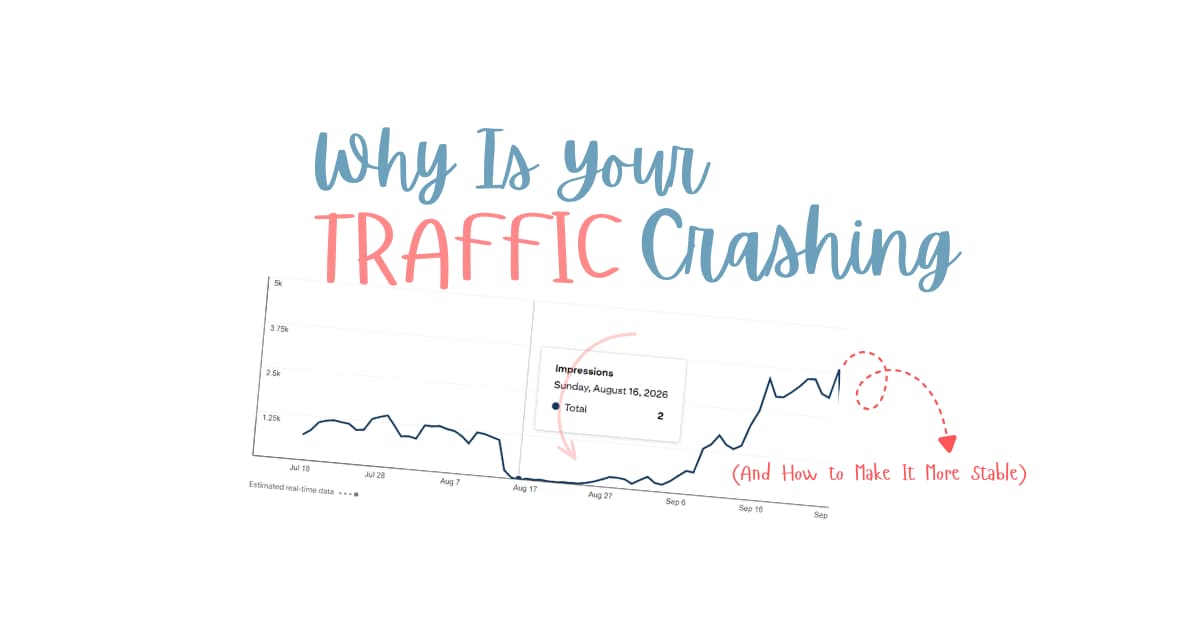
Have you ever checked your Pinterest analytics, felt excited about your traffic going up, and then wondered what happened when it suddenly started dropping again?
One week, you’re getting more clicks than usual. The next week, your traffic is down, and you’re wondering whether something is wrong with your Pinterest account.
I’ve learned that Pinterest traffic doesn’t grow in a perfectly straight line. You can have a few amazing months, experience a drop the following month, and start growing again in the next quarter.
And honestly, this is one of the most frustrating parts of growing a Pinterest account.
You spend time creating pins, publishing blog posts, and targeting keywords, so it’s natural to expect your hard work to lead to consistent traffic. But Pinterest doesn’t always work that way.
The good news? Although you can’t completely eliminate Pinterest traffic fluctuations, you can build a stronger account that’s less dependent on a single pin, keyword, trend, or category.
In this guide, I’ll explain why your Pinterest traffic goes up and down, how to recognize the difference between normal fluctuations and more serious drops, and the strategies I focus on to build a more resilient Pinterest account over time.
Why Does Your Pinterest Traffic Go Up and Down?
Pinterest traffic fluctuates because the platform relies on algorithms, and those algorithms can change over time.
Your content might perform exceptionally well for a few weeks or months, only to slow down later. A pin that previously brought you a lot of clicks might lose momentum, or a trend that generated a significant amount of traffic might eventually become less popular.
And when your traffic depends heavily on those things, the impact can be pretty significant.
Think about it this way.
Let’s say one of your pins performs really well and becomes your main source of website traffic. You’re getting consistent clicks, your analytics look great, and everything seems to be working.
But what happens when that pin starts losing momentum?
If most of your traffic comes from that single pin, your entire account can suffer when its performance declines.
The same thing happens when you depend on one keyword, one popular trend, or one category of content.
The problem isn’t necessarily that your Pinterest traffic fluctuates. The problem is when your entire strategy depends on too few sources of traffic.
This is why I focus on building a more diversified Pinterest strategy rather than trying to make every pin perform perfectly.
You can’t control every algorithm change, but you can create more opportunities for your content to attract traffic.
Are Pinterest Traffic Fluctuations Normal?
Yes, Pinterest traffic fluctuations are normal, and it’s important to understand the difference between a typical decline and a potentially serious traffic drop.
For example, let’s say you’re getting around 100 clicks per day, and your traffic drops to 50 or 60 clicks.
That’s frustrating, of course, but it doesn’t automatically mean something is wrong with your account. Traffic can fluctuate naturally, and you shouldn’t panic every time your analytics show a decline.
Now, imagine getting 1,000 clicks per day and suddenly dropping to zero.
That’s a very different situation and could indicate a more serious issue that deserves further investigation.
The important thing is not to treat every decline as a crisis.
If you check your Pinterest analytics every single day and expect the graph to move upward consistently, you’ll probably end up disappointed. Traffic can rise and fall from week to week, and even accounts that perform well over time can experience slower periods.
I’ve found it more useful to focus on the bigger picture.
Instead of judging your entire Pinterest strategy based on one bad week, look at how you’re building your content library, how many keywords you’re targeting, and whether your account depends too heavily on a small number of successful pins.
The goal isn’t to eliminate every fluctuation.
The goal is to build an account that can handle fluctuations without losing all its traffic whenever something changes.
How to Reduce Major Pinterest Traffic Drops
Although you can’t prevent every Pinterest traffic drop, you can reduce your account’s dependence on individual pins, trends, and keywords.
Here are the main strategies I focus on.
1. Focus on High-Quality Content
Let’s start with something that becomes increasingly important as more content competes for attention on Pinterest: quality.
There is more content available than ever, with more creators, more AI tools, and more competition.
That means Pinterest has more choices when deciding which content to recommend.
If your website looks spammy, your pins look poor, or your articles don’t provide much value, there’s little reason to expect your content to stand out when other creators are offering something better.
And no, I’m not saying every blog post needs to be perfect.
You don’t need to spend weeks polishing every sentence or creating the most elaborate pin design imaginable.
But your content should be useful, your images should look good, and your website should provide a professional experience.
When someone discovers your pin and clicks through to your blog, the article should actually help them with the problem they were trying to solve.
Think about the complete experience:
- Your pins: Do they look good and clearly represent your content?
- Your articles: Are you providing useful information rather than publishing content just to have another URL?
- Your website: Does it look professional and make it easy for readers to explore your content?
All these things matter when you’re building a stronger foundation for your Pinterest account.
My approach is to focus on publishing content that offers real value rather than simply increasing the number of pins or articles I create.
Because creating more content doesn’t automatically mean creating better content.
2. Stop Depending Too Much on Trends
Pinterest trends can be fantastic for generating traffic.
Sometimes, a particular topic becomes popular, and creating content around it can bring a significant spike in clicks.
The problem? Trends eventually die.
A topic that attracts a lot of attention today might not generate the same interest months later. And if most of your Pinterest traffic depends on that trend, your account becomes vulnerable when it loses momentum.
This is why I prefer building a strategy around evergreen content.
Evergreen content covers topics that people continue searching for throughout the year. Instead of being useful only during a short period, these articles can remain relevant for months or even years after publication.
For example, if your blog focuses on a trend that eventually disappears, the traffic associated with that topic may decline.
But if you also have articles targeting ongoing questions, specific problems, and searches that remain relevant throughout the year, you’re creating more opportunities to attract traffic beyond that one trend.
This doesn’t mean you should never publish trending content.
Trends can still be part of your strategy. I simply wouldn’t want my entire Pinterest account to depend on them.
Use trends as an opportunity, but build your foundation around content that can remain useful over time.
That way, when a trend slows down, your entire traffic strategy doesn’t have to slow down with it.
3. Target More Long-Tail Keywords
This is one of the strategies I find particularly important when building a more stable Pinterest account.
Instead of targeting only broad keywords, focus on long-tail keywords that describe more specific searches, questions, and problems.
Why?
Because when your entire strategy revolves around a handful of broad keywords, your traffic can become heavily dependent on how those specific keywords perform.
But when you target hundreds of smaller, more specific searches, you’re creating more opportunities for your content to attract clicks.
Let’s take a food blog as an example.
Instead of targeting only:
- Chicken casserole
You could create content targeting more specific searches, such as:
- Easy chicken casserole for picky teenagers
The second keyword is more specific and describes a clearer need.
The same principle applies to other niches. Instead of focusing exclusively on broad topics, think about the different questions your audience might ask and the specific problems they want to solve.
This is where I would focus my keyword strategy:
- Specific search terms related to your main topic.
- Questions your audience wants answered.
- Problems your readers are trying to solve.
- Different variations of a broader topic.
- Smaller search opportunities that fit your website.
The idea is to create content around a wider range of relevant keywords rather than depending on a few popular ones.
Of course, targeting more keywords doesn’t guarantee that every article will bring traffic. But it gives you more opportunities to build a diversified content library.
And that’s the point.
You don’t want your Pinterest traffic to depend on one keyword performing well. You want multiple articles targeting multiple searches, so one decline doesn’t affect your entire strategy.
4. Diversify Your Pinterest Traffic Sources
If there’s one thing I want you to take away from this article, it’s that diversification matters.
Imagine having a Pinterest account where almost all your traffic comes from one successful pin.
As long as that pin performs well, everything looks great.
But once it slows down, your traffic can drop dramatically.
Now imagine a different account with multiple articles, a wider range of targeted keywords, and content covering several relevant topics.
That account can still experience fluctuations, but it’s not relying on a single piece of content to do all the work.
That’s the kind of foundation I want to build.
Diversification means creating more opportunities for your content to attract traffic instead of putting all your effort into a small number of successful pins or topics.
You can work toward this by:
- Publishing more useful articles that target different keywords.
- Creating content around specific questions and problems.
- Building an evergreen content library.
- Expanding into relevant topics within your niche.
- Avoiding excessive dependence on a single successful pin or trend.
Think about what happens when one of your articles stops performing as well as it used to.
If that article represents almost all your traffic, the impact can be substantial.
But if you have many other articles targeting different searches, you have more opportunities to maintain traffic from the rest of your content.
This is why I don’t want to focus only on making one pin successful.
I want to build an account where multiple pieces of content have the opportunity to contribute to my overall traffic.
The more diversified your strategy becomes, the less dependent you are on any single source of traffic.
5. Expand Your Blog Into More Relevant Categories
Diversification doesn’t stop at keywords and individual articles.
You should also think about the range of topics your website covers.
Let’s say you have a blog about dogs.
If every article focuses exclusively on one narrow subject, your content strategy might become overly dependent on that particular category.
But what if you expanded into other relevant pet topics, such as cats or guinea pigs?
You would have more opportunities to target additional keywords and create content for different searches.
The same principle applies to other niches.
Imagine you run a home decor blog with plenty of articles about decorating ideas.
You could consider expanding into related categories such as cleaning or houseplants.
Instead of relying entirely on one category, you’re creating a broader content library that can attract traffic from multiple topics.
Of course, I wouldn’t recommend adding random categories that have nothing to do with your website simply to publish more articles.
The idea is to expand into relevant areas that make sense for your audience and your overall content strategy.
When you have multiple useful categories, you can target a wider range of keywords and create more opportunities for Pinterest users to discover your content.
And if one category experiences a decline, the rest of your content may still provide opportunities to attract traffic.
A diversified website gives you more than one path to traffic.
Rather than depending on a single topic to carry your entire Pinterest strategy, you’re building a stronger foundation across multiple relevant categories.
6. Improve Your Website User Experience
Your Pinterest strategy doesn’t end when someone clicks on a pin.
You also need to think about what happens after that person lands on your website.
Does your page load quickly?
Is the article useful?
Can visitors easily find the information they came for, or do they leave your website immediately?
These are important questions to consider when evaluating your overall content strategy.
Imagine someone discovers one of your pins because they’re looking for a specific answer. They click through to your article, but the page is slow to load or the content doesn’t provide the information they expected.
That’s not the experience you want to create.
Your goal should be to make the transition from Pinterest to your website as useful and straightforward as possible.
Here’s what I would focus on:
Make your content useful. Your article should answer the question or address the problem that attracted the reader in the first place.
Pay attention to page speed. Think about whether your pages load quickly and provide a smooth experience.
Create a professional website. Your content, images, and overall presentation should feel consistent and trustworthy.
Focus on the reader, not just the click. Getting someone to visit your website is only part of the experience. You also want to give them a reason to stay and engage with your content.
In my view, user experience deserves more attention when building a Pinterest traffic strategy.
The goal isn’t simply to generate clicks at any cost. It’s to create a website experience that supports the quality of the content you’re publishing.
7. Be Consistent With Your Content Strategy
Building a more resilient Pinterest account takes time.
You can’t expect to publish a few articles, target a handful of keywords, and immediately eliminate traffic fluctuations.
The strategies I’ve discussed work together as part of a longer-term approach.
You publish useful content, target more specific keywords, build evergreen articles, expand into relevant categories, and improve your website experience.
Over time, you’re creating a broader foundation for your Pinterest traffic.
And that’s why consistency matters.
Instead of constantly changing your entire strategy every time traffic drops, focus on the elements you can control.
Are you continuing to create useful content?
Are you targeting a variety of relevant keywords?
Are you building more evergreen articles instead of relying entirely on trends?
Are you expanding your content library into relevant categories?
Are you providing a good experience for visitors?
These are the things I would keep working on over time.
You might still experience a decline next week or next month. Your traffic graph might not look the way you hoped it would.
But the goal is to keep building an account that has multiple opportunities to attract traffic instead of relying on one successful pin or keyword.
You cannot control every algorithm update, but you can control the foundation you’re building.
And that foundation becomes more important when you’re thinking about the long-term stability of your Pinterest account.
What to Do When Your Pinterest Traffic Drops
So, what should you actually do when you notice your Pinterest traffic going down?
First, don’t assume every decline means your account has a serious problem.
A smaller drop, such as going from 100 clicks per day to 50 or 60, isn’t automatically a reason to panic. Traffic fluctuations are part of working with a platform that relies on algorithms.
However, if your traffic suddenly falls from 1,000 clicks per day to zero, that’s a much more significant change and could indicate a more serious issue.
The first step is to recognize the difference between those situations instead of treating every decline the same way.
After that, I’d focus on reviewing the strength of your overall strategy.
Ask yourself these questions:
- Does most of my traffic come from one successful pin?
- Am I relying too heavily on one keyword or trend?
- Do I have enough evergreen content?
- Am I targeting specific long-tail keywords?
- Does my website cover several relevant categories?
- Is my content useful, professional, and easy to access?
- Am I consistently building a broader content library?
These questions help you think beyond the immediate traffic graph.
If your strategy depends heavily on a single source of traffic, that’s an area worth reconsidering.
Instead of trying to force your analytics to move upward every day, focus on reducing that dependence and creating more opportunities for your content to perform.
And remember, even a strong account can experience fluctuations. The objective isn’t to build an account that never experiences a decline.
It’s to build one that isn’t completely dependent on a single pin, keyword, or trend.
Why does my Pinterest traffic keep going up and down?
Pinterest traffic can fluctuate because the platform relies on algorithms, and content performance can change over time. A successful pin may lose momentum, a trend may become less popular, or your traffic may decline for a period before growing again.
The important thing is to distinguish normal fluctuations from sudden, significant drops that may indicate a more serious issue.
Is it normal for Pinterest traffic to drop suddenly?
Some declines are a normal part of Pinterest traffic fluctuations, but the size of the drop matters.
For example, going from 100 clicks per day to 50 or 60 is different from suddenly dropping from 1,000 clicks per day to zero. The latter deserves closer attention because it could indicate a more serious problem.
How can I make my Pinterest traffic more stable?
You cannot eliminate Pinterest traffic fluctuations completely, but you can build a more resilient account by focusing on several strategies:
- Publish high-quality content that provides value.
- Prioritize evergreen articles.
- Target specific long-tail keywords.
- Diversify your content and keyword strategy.
- Expand into relevant website categories.
- Improve your website user experience.
- Continue building your content library consistently.
These strategies help reduce your dependence on individual pins, keywords, and trends.
Does evergreen content help reduce Pinterest traffic fluctuations?
Evergreen content can help you build a more stable foundation because it remains useful for months or even years after publication.
Rather than relying entirely on trends that may eventually lose popularity, you can create articles around topics, questions, and problems that remain relevant throughout the year.
This gives you more opportunities to attract traffic beyond short-lived trends.
Why are long-tail keywords important for Pinterest traffic?
Long-tail keywords allow you to target more specific searches, questions, and problems.
Instead of relying on a few broad keywords, you can build a larger content library around hundreds of smaller, more specific searches.
This creates more opportunities for your content to attract traffic and reduces your dependence on a small number of keywords.
Should I focus on trends or evergreen content?
I prefer prioritizing evergreen content while still recognizing the value of trends.
Trends can generate significant traffic spikes, but they eventually lose popularity. Evergreen content, on the other hand, can remain useful for months or years.
Combining a strong evergreen foundation with opportunities to cover trends helps prevent your entire strategy from depending on the popularity of one topic.
Can diversifying my blog categories help stabilize Pinterest traffic?
Expanding into relevant categories can create opportunities to target more keywords and reach different searches.
For example, a dog blog could expand into other pet topics, while a home decor blog could add relevant sections about cleaning or houseplants.
The important thing is to choose categories that make sense for your website and audience.
Final Thoughts
Pinterest traffic fluctuations can be frustrating, especially when you’ve invested so much time into creating content and growing your account.
But here’s what I want you to remember: you don’t need to eliminate every traffic fluctuation to build a successful Pinterest strategy.
You need to build an account that isn’t completely dependent on one successful pin, one keyword, one category, or one trend.
That’s why I focus on publishing quality content, targeting long-tail keywords, prioritizing evergreen articles, diversifying my content strategy, and improving the overall experience I provide to readers.
These things won’t guarantee that your traffic graph will always move upward. Nothing in this strategy can give you complete control over Pinterest’s algorithms.
But they can help you build a stronger foundation with more opportunities to attract traffic over time.
So, the next time you notice your Pinterest traffic dropping, don’t immediately assume that everything is going wrong.
Look at the bigger picture.
Are you building a useful content library? Are you targeting a variety of relevant searches? Are you expanding into different categories? Are you creating content that can remain useful long after publication?
Keep working on those things consistently.
Because instead of chasing perfectly stable traffic, I’d rather build a Pinterest account that’s better prepared to handle whatever fluctuations come next.
And that’s the strategy I’d focus on for the long term!