
Pinterest affiliate marketing can look deceptively simple. Create a few attractive Pins, add links, and wait for commissions to roll in.
But what actually happens when you put Pinterest marketing strategies into practice? How much traffic can Pinterest drive to a website, and what does it take to turn that traffic into affiliate income?
That’s what makes Pinterest affiliate marketing case studies so useful. Instead of relying on vague promises about making money online, we can look at reported results, the strategies behind them, and the lessons that affiliate marketers can apply to their own businesses.
In this guide, I’m bringing together four Pinterest marketing case studies covering affiliate commissions, website traffic, Pinterest SEO, and monthly impressions. Each one highlights a different part of the process, from creating your first Pins to building a strategy that attracts clicks and supports long-term growth.
You’ll discover how one affiliate marketer earning more than $2,000 in commissions in three months, how a niche website generated thousands of visitors from Pinterest, and why getting millions of impressions doesn’t automatically translate into sales.
More importantly, I’ll break down the strategies behind these results so you can understand what matters most when building a Pinterest affiliate marketing business.
Pinterest Affiliate Marketing Case Studies at a Glance
Before diving into each case study, let’s look at the results and what they demonstrate.
| Case study | Reported result | Main lesson |
| New niche website | More than 17,000 social visitors, including nearly 12,000 from Pinterest | Pinterest can help a new website attract early traffic |
| 3 month affiliate experiment | $2,073.46 in commissions during month three | Focused content, keyword optimization, and successful Pin variations can support affiliate sales |
| Creative business and website | 3 million Pinterest impressions and around 2,000 website clicks in one reported month | High reach can bring targeted visitors, but impressions and clicks are different metrics |
| Pinterest account growth | 1 million monthly views during the first month of an account launched in 2017 | Pin design, keyword relevance, engagement, and timing can influence reach |
Case Study 1: How a New Niche Website Got 12,000 Pinterest Visitors
The first case study follows a niche website launched in October 2018 by Christy, an affiliate marketer who was already earning more than $5,000 per month by January 2021.
The Pinterest results discussed here cover the website’s first ten months, from October 2018 through July 2019.
What makes this example particularly interesting is that Pinterest wasn’t chosen because the website owner loved social media. In fact, she wanted to avoid the workload of managing multiple social channels while building a new website.
Instead, she chose Pinterest as a relatively manageable way to attract early visitors.
The goal: Get traffic before Google gained traction
When starting a niche website, getting those first visitors can be challenging. Publishing content doesn’t automatically mean people will discover it immediately.
Christy had three main objectives for Pinterest:
- Generate starter traffic for a brand-new website.
- Increase her chances of reaching the qualified sales threshold required for Amazon Associates approval.
- Build another traffic source that could continue sending visitors over time.
Notice that these goals went beyond simply increasing Pinterest followers.
She wanted visitors who would reach her website, explore her content, and potentially contribute to her affiliate business.
This distinction matters because an audience on Pinterest is only useful to an affiliate website when the strategy helps move people toward a meaningful business outcome.
The three-step Pinterest strategy
Rather than publishing Pins randomly, Christy created a repeatable process.
Step 1: Create a Pinterest optimization checklist
Every Pin needed to meet a set of basic requirements before publication.
Her checklist included:
- A keyword-rich description.
- A relevant image.
- Keyword-rich text within the image.
- Three to five relevant hashtags.
- A link to a specific blog post.
This checklist helped make Pinterest publishing more systematic. Instead of reinventing the process for every graphic, she could follow the same steps repeatedly.
For affiliate marketers, this is a useful approach. A checklist reduces the chances of publishing a visually appealing Pin that lacks the information needed to help people discover it or reach the intended content.
Step 2: Research keywords directly on Pinterest
One of the most important lessons from this case study is that Google keyword research and Pinterest keyword research aren’t always interchangeable.
A phrase that makes sense for a blog post might not be the phrase Pinterest users actually search for.
For example, Christy described targeting a blog keyword similar to “best chew toy for small dogs.” When she entered the phrase into Pinterest’s search bar, the platform suggested related searches such as “best chew toy for dogs” and “best dog toys for chewers.”
Those suggestions gave her alternative keyword ideas for her Pins.
The lesson is straightforward: don’t assume your blog’s primary keyword should automatically become your Pin’s target keyword.
Start with your existing content, then research how Pinterest users search for that topic. Use relevant search phrases in your Pin titles, descriptions, and on-image text.
Step 3: Create click-worthy Pins efficiently
Christy used Canva to create branded Pin templates.
After spending time creating graphics manually in Photoshop, she found that using templates made the process much faster. She reported being able to create a Pin graphic in less than a minute with Canva.
She then used her checklist to optimize each graphic and published it to a relevant Pinterest board.
For example, a website about dogs might have boards dedicated to dog toys, dog grooming, and dog health.
The goal is to keep each Pin aligned with the content it promotes and the topic of the board where it appears.
The results: Pinterest became a meaningful traffic source
The website’s reported results over the first ten months were impressive.
| Metric | Reported result |
| Total social traffic, October 2018–July 2019 | More than 17,000 visitors |
| Pinterest’s share of social traffic | Approximately 66% |
| Estimated Pinterest-driven visitors | Nearly 12,000 |
| Monthly Pinterest viewers by July 2019 | More than 123,000 |
| Pinterest boards | 13 |
| Pins created from her own content and repinning | 499 |
| Pinterest followers | Nearly 300 |
| Highest reported Pin click-through rate | 4.2% |
One particularly interesting detail is that the website had approximately 150 blog posts, although much of the content was only three to four months old during the period discussed.
This shows how Pinterest can complement a growing content library. Instead of publishing a blog post and moving immediately to the next one, you can create a visual entry point that helps people discover the article.
What happened when a Pin unexpectedly took off?
Christy noticed a traffic spike in mid-July 2019 and traced it back to a Pin published on July 14.
The Pin promoted a new blog post that she hadn’t expected to perform particularly well.
It became her second-highest-performing Pin by impressions at the time, and her top five Pins had collectively generated more than 1,400 website clicks.
This is an important reminder that performance isn’t always easy to predict before publication.
Rather than spending all your time trying to identify a guaranteed winner, create a repeatable process, monitor your analytics, and pay attention when a Pin performs better than expected.
What I’d take away from this case study
The strongest lesson here is that Pinterest doesn’t need to become your entire marketing strategy to be valuable.
Christy continued prioritizing blog content while using Pinterest to diversify traffic. She also identified opportunities to improve her results through design testing, better descriptions, and closer analysis of underperforming Pins.
For a new affiliate website, Pinterest can serve as an additional traffic channel while organic search visibility develops.
The key is to build a process that fits your workload rather than letting Pinterest consume all the time you need for creating useful website content.
Original source: https://nichesiteproject.com/amazon-affiliate/pinterest-affiliate-marketing/traffic/
Case Study 2: How Pinterest Affiliate Marketing Generated $2,073 in Three Months
The second case study follows Johnathan Reeper, who documented a 90-day Pinterest affiliate marketing experiment in an article published on November 9, 2025.
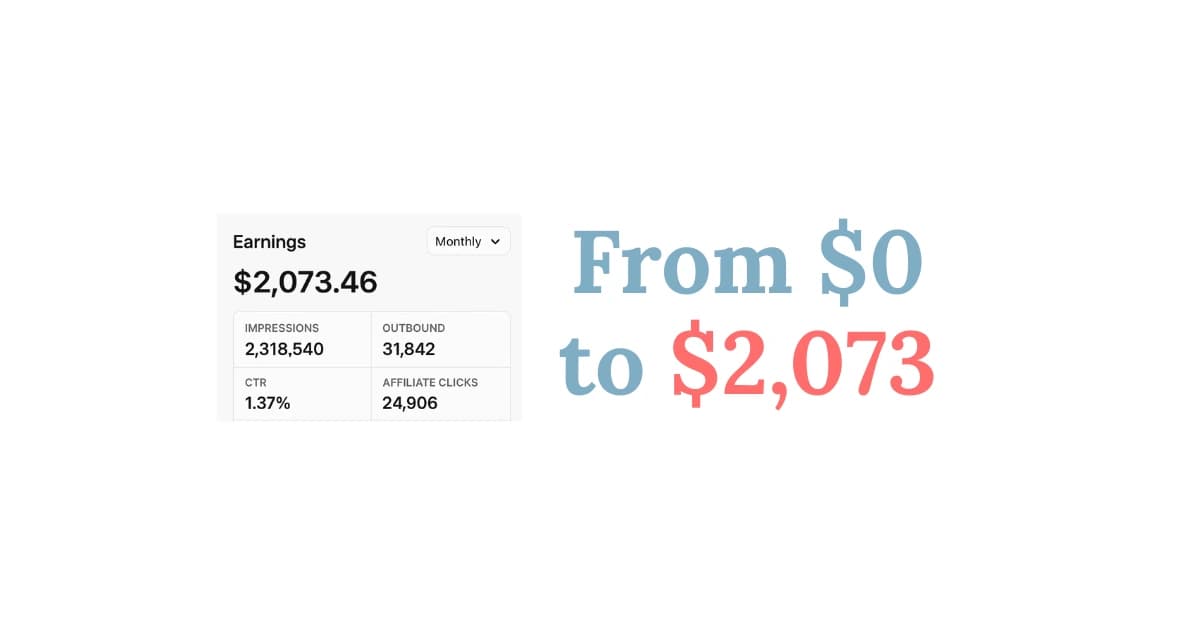
His reported result was $2,073.46 in affiliate commissions during his third month.
Unlike the first case study, which focused primarily on website traffic, this experiment provides a month-by-month breakdown of impressions, clicks, orders, and commissions.
That makes it useful for understanding how activity and content focus changed alongside reported affiliate revenue.
The niche and initial setup
Johnathan chose the self-improvement niche, focusing on two subtopics:
- Daily habit tools, including journals, planners, vision-board kits, and productivity books.
- Simple health upgrades, including at-home workout essentials.
He then created a Pinterest business account so he could access analytics and monitor impressions, clicks, and board performance.
He organized the account around eight boards, including topics such as Morning Routine, Goal Setting, and Home Workout.
The idea was to establish a clear niche rather than publishing unrelated content across a broad collection of topics.
For affiliate programs, he initially used Amazon Associates and later expanded to Impact and ClickBank.
His approach also involved sending Pinterest users to website content, such as product reviews, rather than treating every Pin as a standalone sales pitch.
The important distinction is that the Pin attracts attention, while the destination gives visitors more information about the product and an opportunity to purchase.
Month 1: Lots of Pins, little direction
During the first month, Johnathan published 110 image Pins across seven boards.
His content included a mixture of home décor, books, fitness gear, and motivational quotes. He described this initial stage as lacking a clear strategy.
The results reflected the modest start.
| Metric | Month 1 |
| Impressions | 32,418 |
| Clicks | 297 |
| Orders | 2 |
| Affiliate commissions | $3.27 |
The earnings were small, but the experiment had generated two orders.
More importantly, the initial results gave him a starting point for evaluating what to change.
The first lesson is that publishing a large number of Pins doesn’t automatically create meaningful affiliate income. If your content lacks a clear focus, it may struggle to reach the right audience or attract people interested in the products you’re promoting.
Month 2: More consistency and better-performing content
In month two, Johnathan increased his publishing activity to approximately eight to ten Pins per day and introduced short videos.
He also began identifying which products and creative approaches were generating better results.
| Metric | Month 2 |
| Impressions | 186,209 |
| Outbound clicks | 3,214 |
| Orders | 61 |
| Affiliate commissions | $248.90 |
Compared with the first month, the improvement was substantial.
He also noticed that creating multiple Pins around the same product helped increase his opportunities for sales. Rather than relying on a single graphic, he recreated successful Pins using different designs.
Two products accounted for approximately 85% of his reported commission income during this month.
Their Pins also had click-through rates above 4% and were being saved hundreds of times.
This suggests a practical direction for affiliate marketers: once you identify a product that attracts interest, test different ways of presenting it instead of constantly moving to unrelated products.
A product can be promoted through different angles, benefits, and visual layouts while the destination remains relevant to the Pin.
Month 3: Scaling to $2,073.46 in commissions
After seeing improvement in the second month, Johnathan significantly increased his activity.
He reported publishing approximately 30–40 Pins per day and spending substantial time designing graphics, scheduling content, and writing affiliate product reviews.
The results were:
| Metric | Month 3 |
| Outbound clicks | Approximately 31,000 |
| Sales | 612 |
| Affiliate commissions | $2,073.46 |
| Advertising spend | $0 reported |
The increase in commissions was significant, moving from $3.27 in month one to more than $2,000 in month three.
However, it’s important to understand what this result does and doesn’t tell us.
It demonstrates what Johnathan reported achieving during his experiment. It doesn’t establish that publishing 30–40 Pins a day will produce the same result for another account.
He also described month three as extremely demanding. Pinterest had effectively become a second full-time job, with early mornings spent designing and scheduling Pins and evenings devoted to writing product reviews.
That workload is worth considering before attempting to reproduce the strategy.
Pinterest SEO was another important turning point
Johnathan identified Pinterest SEO as a major part of his improvement.
He began using titles that reflected the phrases people might search for, such as:
- “Morning journal prompts”
- “Apartment gym essentials”
- “Weekly planning template”
He also found that leading with an outcome could outperform simply naming a product.
For example, he reported that a Pin titled “Plan your week in 10 minutes” achieved a click-through rate more than 60% higher than a Pin titled “Undated Planner.”
The difference is that the first title communicates a potential benefit, while the second primarily identifies the product.
For affiliate marketers, this provides a useful principle: your Pin should make the value of clicking clear.
Instead of focusing exclusively on a product name, consider the problem it helps solve or the outcome the audience is looking for.
What I’d take away from this case study
Three lessons stand out.
First, focus matters. Johnathan’s early account contained a broad mixture of content, while his later strategy became more deliberate.
Second, test variations of content that already show promise. His reported results suggest that multiple creative approaches around successful products can create more opportunities for clicks and sales.
Third, track the entire journey from impressions to commissions. A Pin with impressive reach isn’t necessarily the Pin generating the most revenue.
His results also highlight a trade-off between growth and workload. Scaling output can demand considerably more time, so the goal should be to find a repeatable process that fits your available resources.
Original source: https://medium.com/writers-blokke/how-i-made-2-000-in-3-months-with-pinterest-affiliate-marketing-829abfe91a8a?sk=e08d9cdfe181b93d9ace2f5993a4b35c
Case Study 3: How Pinterest SEO Generated 3 Million Impressions
The third case study comes from Superhero Design Co, a creative business promoting Showit templates, Canva templates, branding services, blog posts, and free resources.
The business reported receiving 3 million Pinterest impressions during one month, alongside approximately 2,000 website clicks and hundreds of sales.
The owner also described Pinterest as a major source of the business’s online success.
This case study is particularly useful because it demonstrates how Pinterest marketing can support more than traditional affiliate websites. The same basic principles of visual discovery and keyword optimization can help a business promote its own products and services.
The role of Pinterest in website traffic
The reported results were:
- 3 million Pinterest impressions in one month.
- Approximately 2,000 website clicks.
- Hundreds of sales.
- Hundreds of new email subscribers.
These metrics describe different stages of the marketing process.
Impressions indicate how often Pins were shown. Website clicks represent visitors who moved from Pinterest to the destination. Sales and email sign-ups reflect further actions taken after people arrived.
This distinction is important for affiliate marketers because a large impression count doesn’t automatically mean a large number of affiliate conversions.
A Pin may reach a huge audience but generate relatively few website visits. Another Pin may attract fewer impressions while bringing visitors who are much more interested in the offer.
The objective isn’t simply to maximize visibility. It’s to attract the right visitors and give them a useful next step.
How the business approached Pinterest SEO
The owner emphasized several areas of optimization.
1. Optimize the Pinterest business profile
The business used a profile name that explained both the brand and what it offered.
The recommended approach was to combine the business name with a relevant description of its products or services, then write a bio that naturally included the terms the target audience might search for.
For an affiliate marketer, this means making your niche clear.
A profile dedicated to home organization, for example, should communicate that focus rather than mixing unrelated topics without a clear purpose.
2. Organize boards around relevant topics
The business emphasized keeping public boards aligned with its niche.
For example, a designer could create boards related to website templates, brand design, and design inspiration rather than filling the same profile with unrelated recipes or outfit ideas.
The principle is simple: make it easy for people to understand what your account offers and find the content that interests them.
For an affiliate website, boards can be organized around categories that naturally match the content and products being promoted.
3. Write descriptions for people, not just search engines
One of the most useful observations in this case study concerned Pin descriptions.
The owner explained that relying only on keywords had previously led to poor click-through and conversion results.
Why? Because descriptions that read like lists of keywords don’t necessarily give people a reason to click.
A better approach combines relevant search terms with clear, natural language explaining what the visitor will find.
For example, a Pin promoting website templates could explain who the templates are designed for, what they help users create, and what makes them useful.
For affiliate marketing, the same principle applies to product recommendations.
A Pin promoting a planner could focus on the planning problem it helps address, while the description provides context that matches the linked review or recommendation page.
The goal is to help Pinterest understand the topic without making the description sound unnatural to a human reader.
4. Use attractive visuals that accurately represent the destination
Visual design was another major focus.
The business recommended creating professional, eye-catching Pins that clearly communicate the product or value offered by the linked page.
The graphics should accurately represent what people can expect after clicking.
This matters because a Pin can attract attention through its design, but if the destination doesn’t match the promise, the visitor may not find what they expected.
The business used Canva to create its Pins and adapt existing design templates to the Pinterest format.
For affiliate marketers, a useful starting point is to create several branded templates that can be adapted to different articles and products without designing every graphic from scratch.
What I’d take away from this case study
The most important lesson is that Pinterest SEO and conversion-focused content need to work together.
Keywords can help your content become discoverable, but the design and description need to communicate a clear reason to click.
This case study also reinforces the difference between traffic and business outcomes.
Three million impressions is a substantial reach figure, but the approximately 2,000 website clicks show why it’s necessary to track the next step in the funnel.
For an affiliate marketer, I would pay attention to:
- Which Pins generate impressions.
- Which Pins generate outbound clicks.
- Which destination pages receive those visitors.
- Which pages lead to affiliate purchases or other meaningful actions.
That is how you begin distinguishing Pins that look popular from Pins that contribute to your business.
Original source: https://superherodesign.co/how-i-optimized-my-pinterest-seo-to-get-my-website-3-million-impressions-in-30-days
Case Study 4: How a Pinterest Account Reached 1 Million Monthly Views
The fourth case study comes from Nadalie Bardo, who described reaching one million monthly Pinterest views during the first month of an account she launched in 2017.
She later built multiple Pinterest accounts and shared strategies for improving reach, encouraging saves, and creating Pins that attract clicks.
Although this case study focuses more on Pinterest growth than affiliate commissions, it provides useful context for understanding how an affiliate marketer can build visibility.
After all, people need to discover your content before they can click through to your website or purchase through an affiliate link.
Why one million monthly views doesn’t tell the whole story
Pinterest impressions measure how often Pins appear on a screen. They don’t automatically tell you how many people clicked, visited your website, or purchased a product.
Nadalie highlighted an important measurement issue: the overall monthly views shown on a Pinterest profile can include content saved from other creators, not just Pins you created yourself.
This means a profile with one million monthly views doesn’t necessarily have one million views on its own original Pins.
For business purposes, it’s important to look beyond the headline number and inspect the analytics for content connected to your own website.
The distinction is especially important when evaluating Pinterest affiliate marketing case studies.
A profile may look successful based on its visibility, but if most of that visibility doesn’t lead to your own content, it may not contribute much to affiliate revenue.
Her first strategy: Prioritize original Pins
Nadalie emphasized prioritizing original Pins that link to your own website or business.
Rather than concentrating on repinning other creators’ content, her approach focused on giving Pinterest users more opportunities to discover and save her own material.
She also explained that saves matter because they can help a Pin reach additional people through other users’ boards.
For an affiliate marketer, this suggests an important priority: create content that people genuinely want to keep, revisit, and share.
A useful Pin might summarize a list of ideas, highlight an attractive product, or provide a quick overview of a solution discussed in a longer article.
The Pin should offer enough value to interest the viewer while making the linked content a natural next step.
Her second strategy: Create Pins people want to save and click
Nadalie described saves and clicks as two important actions to encourage.
A save gives someone a way to keep an idea for later, while an outbound click takes the person to the linked website or shop.
She recommended using clear calls to action, such as “Save for Later” or “Pin Me,” where appropriate.
This makes the intended action easier to understand.
However, saves and outbound clicks serve different purposes. A Pin can receive many saves without necessarily producing a proportional increase in website traffic.
For affiliate marketing, I’d treat saves as one useful engagement signal rather than a substitute for outbound clicks and affiliate conversions.
Her third strategy: Test different Pin designs
The case study describes several Pin formats that Nadalie considered effective for attracting attention and saves.
These included:
- Listicle Pins: Graphics featuring lists of tips, ideas, steps, or reminders.
- Notes app Pins: Screenshot-style graphics that present a short outline or list.
- AI-designed graphics: Illustrations or visual backgrounds paired with text.
- Interactive collage Pins: Collages containing multiple visual elements.
- Image-only Pins: Photographs presented without text overlays or extensive branding.
These formats provide different ways to communicate information visually.
For an affiliate marketer, the right choice depends on the product and the content being promoted.
A listicle Pin might work naturally for an article about product recommendations. A clean product photograph may be more suitable when the product itself is the main attraction. A notes-style graphic could summarize a short checklist or set of ideas.
Rather than assuming one design works for every topic, create variations and evaluate which ones attract meaningful engagement.
Nadalie also noted that successful design styles can change over time. A format that worked well in one period may not perform the same way later.
Her fourth strategy: Align Pins with timely topics
Seasonal content was another major part of her approach.
Nadalie described how content related to holidays, seasonal activities, and major planning periods can attract attention when people are actively looking for relevant ideas.
Examples included:
- Christmas and New Year.
- Back-to-school season.
- Thanksgiving.
- Spring and Easter.
- Summer vacations.
- Weddings and graduations.
Even businesses that sell products throughout the year can create content around relevant seasonal needs.
For example, a productivity affiliate website could promote planning resources around New Year goal-setting, while a home-related website could create content around seasonal organization.
The important point is to remain relevant to your niche rather than chasing trends that have little connection to your audience or offers.
Her fifth strategy: Use keywords to support discovery
Nadalie emphasized placing relevant keywords in Pin titles, descriptions, and board titles and descriptions.
She also discussed using Pinterest Trends and Google Trends to identify topics that attract interest at different times of the year.
This connects directly to the first case study: keyword research should reflect how people search for content on Pinterest, not simply copy the exact keywords used in a blog post.
When you combine relevant keywords with an appealing design and useful destination content, you create a clearer path from discovery to website traffic.
What I’d take away from this case study
The biggest lesson is that reach is only one part of Pinterest marketing.
Nadalie’s experience shows how original content, engaging designs, saves, timely topics, and keyword relevance can contribute to visibility.
For affiliate marketers, the next step is to connect that visibility to a relevant destination and track what happens after the click.
A million monthly views might look impressive, but a smaller audience that consistently clicks through to useful product reviews can also be valuable.
Don’t let a large impression count distract you from the actions that actually support your business goals.
Original source: https://yourpincoach.com/how-i-got-1-million-monthly-views-on-pinterest/
Case Study 5: Nearly 1 Million Pinterest Impressions in 30 Days—but Almost No Clicks
One of the most eye-opening Pinterest affiliate marketing case studies involved two Pinterest accounts that generated nearly one million combined impressions in 30 days. Despite that impressive reach, the accounts received just 85 outbound clicks.
The results showed me why impressions alone are not enough to build a profitable Pinterest affiliate marketing strategy.
The results behind the impressions
The first account focused on home organization and interior aesthetics. One monochrome marble bathroom pin generated 277,000 impressions, while the account reached 472,000 people during the month. Despite that visibility, it received only 44 outbound clicks.
The second account focused on meal prep and healthy recipes. A grilled chicken dinner pin attracted 62,000 impressions, and the account surpassed 200,000 impressions within its first 30 days. However, it generated only 41 outbound clicks.
Together, the two accounts achieved nearly one million impressions but very little website traffic.
Why the accounts struggled to generate clicks
The home organization account had a sequencing problem. Its owner focused on growing reach before preparing an affiliate storefront to capture that attention. The content gained visibility, but the monetization destination was not ready.
The meal prep account had a different issue. It already offered a $7.99 healthy meal-prep ebook and included a link in the profile, but the pins did not clearly tell people what they would find after clicking.
The missing element was a clear call to action.
Instead of simply sharing attractive food photography, the pin descriptions needed to explain the benefit of clicking, such as learning how to prepare healthy meals for the entire week.
The account owner added a sentence communicating that benefit, although results from the change had not yet been reported.
What I learned from this case study
This case reinforced an important lesson: Pinterest impressions indicate visibility, not revenue.
A pin can perform well in search and attract saves without sending visitors to a website. For affiliate marketing, the next step must be obvious. Readers need to understand what the link offers, why it is relevant, and what they should do next.
My takeaway is to prepare the destination and call to action alongside the content—not wait until after a pin starts receiving impressions.
Original source: https://medium.com/@vanessa_levin/nearly-1-million-impressions-in-30-days-i-made-almost-nothing-from-it-3e0549fcf463
Case Study 6: How a Creator Reached 78 Million Pinterest Impressions Without Paid Ads
Another case study focused on building Pinterest reach through consistent publishing, search optimization, and an organized content workflow.
Sweta Sharma of Breakout Insights reported growing her Pinterest presence from zero to 78 million impressions without spending money on ads. Her experience emphasized that Pinterest growth involves more than designing attractive pins. It also requires a repeatable system.
1. Optimize the Pinterest profile
The first step is making the profile easy to understand. A descriptive profile name can communicate the account’s niche, while the bio should explain who the creator helps and what visitors can expect.
For example, a food creator might use a profile name that includes easy vegan recipes and meal prep rather than only their personal name.
The case study also recommends using a clear profile picture, a relevant banner, and claiming the website when one is available.
2. Turn one piece of content into multiple pins
One of the most useful strategies is breaking a larger piece of content into smaller, searchable ideas.
For example, a blog post about productivity hacks could become separate pins about the Pomodoro Technique, time blocking, productivity apps, and planning the day ahead.
Each pin can target a different search phrase while directing interested readers to the same relevant article.
For affiliate marketers, this approach can also be applied to product reviews, buying guides, comparisons, and tutorials. A single article can support several distinct pins without requiring an entirely new blog post for every design.
3. Create a repeatable pinning workflow
The creator recommends organizing pin production into specific tasks:
- Research keywords and write pin titles.
- Collect images and create designs in batches.
- Write descriptions and prepare destination links.
- Assign pins to relevant boards.
- Schedule content and review performance.
Batching similar tasks can reduce the time lost switching between research, writing, design, and publishing.
Organizing files by niche, month, and production status also makes it easier to manage a growing pin library.
4. Optimize titles, descriptions, boards, and alt text
Pinterest search optimization was another major part of this case study.
The recommendations included using descriptive, keyword-focused board names, writing relevant board descriptions, and creating pin titles that accurately reflect the linked content. The creator also recommends adding descriptive alt text to pin images.
Descriptions should remain natural and useful rather than becoming lists of repetitive keywords.
5. Stay consistent and review analytics
The case study suggests starting with a manageable publishing routine and increasing volume as the workflow improves. It recommends experimenting with scheduling tools, including Buffer, while noting that manual publishing and Pinterest’s native scheduler are also options.
The creator’s suggested posting volume is more aggressive than some other case studies. That difference matters: there is no single publishing frequency demonstrated to work for every account.
Instead, I would use the approach as a starting point, track impressions, saves, engagement, and outbound clicks, and increase publishing only when quality and consistency can be maintained.
What I learned from this case study
The biggest lesson is that Pinterest growth becomes easier to manage when content creation is treated as a system rather than a daily scramble.
For affiliate marketing, a repeatable workflow helps create multiple entry points to useful content, maintain consistent publishing, and identify which topics attract the right audience.
Original source: https://thebreakoutinsights.substack.com/p/15-best-pinterest-tricks-that-helped
Case Study 7: 1.6 Million Pinterest Impressions in 21 Days for a Fashion Resale Business
A business owner who had previously used Pinterest mainly for personal inspiration decided to experiment with it as a traffic channel for a clothing resale business.
Within 21 days, one Pinterest account reportedly generated 1.6 million impressions, approximately 87,000 engagements, 32,000 saves, and around 1,500 outbound clicks.
The account focused on outfit inspiration and shopping-related fashion content.
The strategy: Curated content with a clear shopping direction
Rather than creating every image from scratch, the owner curated content from other creators, gave credit, and added descriptions encouraging viewers to visit the business website to shop for similar products.
The publishing routine involved spending time in the morning and evening sourcing and posting content. The owner initially published roughly 280 pins during the first week, then continued at approximately three to nine pins per day.
This strategy differed from approaches centered on publishing only original pins. It relied on curated fashion inspiration paired with a shopping-related call to action.
The numbers behind the growth
| Metric | Reported result |
| Impressions | 1.6 million |
| Engagements | 87,000 |
| Saves | 32,000 |
| Outbound clicks | Approximately 1,500 |
| Best-performing pin | 50,000 impressions |
| Reported business sales | Nearly 10 per day |
The owner believed Pinterest was helping the business generate sales, but could not verify exactly how many purchases came directly from Pinterest because the store’s reporting did not show that attribution.
That distinction is important. The reported sales were happening while the Pinterest strategy was running, but the available data did not establish that Pinterest caused every sale.
What the owner believed helped the pins perform
The strategy included descriptive titles, pin descriptions, credit to the original content creator, and calls to action encouraging viewers to shop for similar items or visit the website.
The owner also experimented with multiple Pinterest accounts and different content categories, including complete outfit inspiration, individual clothing items, and miscellaneous thrift-store or wholesale ideas.
Some accounts performed better than others, and the experiments were ongoing.
The owner believed engagement and saves were important signals behind continued distribution. However, the results did not establish a universal ranking formula or prove that hashtags were unnecessary for every account.
What I learned from this case study
This example demonstrates the potential of Pinterest as a discovery channel for visually appealing products. It also reinforces the importance of measuring outbound clicks instead of judging success only by impressions.
For affiliate marketers, the transferable lesson is to connect inspiration to a relevant next step: a product review, shopping guide, comparison page, or affiliate recommendation.
There is also an important limitation. This case relied on curated third-party content, and its reported reach should not be treated as proof that the same approach will work for every niche. Anyone adapting the strategy should ensure they have the necessary rights or permission to reuse content and should follow the relevant platform and affiliate disclosure requirements.
What These Pinterest Affiliate Marketing Case Studies Teach Us
Now that we’ve looked at all four examples, let’s bring the lessons together.
Although the businesses and results differ, several recurring themes appear across the case studies.
1. Pinterest SEO is a foundation, not an optional extra
Every case study reinforces the importance of helping Pinterest understand what your content is about.
That means using relevant keywords in Pin titles, descriptions, and board information.
But keyword optimization isn’t simply about inserting as many phrases as possible.
Your keywords need to match the content, the audience’s search intent, and the destination linked from the Pin.
A Pin about a planner should lead to relevant planner content. A graphic promoting a product comparison should lead to a page that actually compares the products.
When the topic, creative, and destination align, users have a clearer reason to click.
2. More Pins don’t automatically mean more income
Johnathan’s three-month experiment involved a substantial increase in publishing volume. Meanwhile, Nadalie’s advice emphasized that consistently creating high-quality Pins can be more useful than overwhelming yourself with an excessive posting schedule.
These approaches aren’t necessarily contradictory.
Johnathan reported scaling up aggressively during a short experiment, while Nadalie described a more measured approach to sustainable Pinterest marketing.
The right lesson isn’t that every affiliate marketer should publish 30–40 Pins daily or that there’s one universal posting frequency.
It’s that publishing volume needs to be balanced with relevance, quality, and the time you can realistically commit.
Start with a manageable routine, monitor your results, and increase production when you have a clear reason to do so.
3. Multiple Pin designs create more opportunities to find winners
Both the affiliate experiment and the Pinterest growth case study highlight the value of creating variations.
Different people respond to different visual styles and ways of presenting the same idea.
You might promote one article with a listicle Pin, a product-focused graphic, and a benefit-driven design.
The destination can remain the same while the creative approach changes.
This also makes it easier to test what works. If one design consistently attracts more outbound clicks than another, you have a useful signal for your next batch of Pins.
The important thing is to measure results rather than assuming that the most attractive design will automatically perform best.
4. Impressions, clicks, and commissions are different metrics
This is one of the most important lessons across all four case studies.
A Pin can receive thousands of impressions without generating many website visits. A Pin that generates clicks may still fail to produce affiliate sales.
Each metric answers a different question.
| Metric | What it tells you |
| Impressions | How often your Pin was shown |
| Saves | How often people saved your Pin |
| Outbound clicks | How often people clicked through to the destination |
| Click-through rate (CTR) | The proportion of impressions that resulted in the measured click action |
| Affiliate orders | How many tracked purchases were attributed to your affiliate activity |
| Affiliate commissions | The earnings reported from those attributed purchases |
For affiliate marketers, this distinction helps identify where a strategy needs attention.
If impressions are low, you may need to improve discoverability or the relevance of your content.
If impressions are strong but outbound clicks are weak, the design, title, or offer presentation may need testing.
If clicks are coming through but commissions remain low, examine whether the destination content matches the Pin, helps visitors evaluate the product, and makes the next step clear.
These are diagnostic possibilities, not guaranteed explanations. The point is to use your own data to decide what to investigate next.
5. Focus on content that serves a clear audience
The strongest results in these examples weren’t simply about publishing random graphics.
The niche website used Pins to promote existing blog content. Johnathan concentrated on self-improvement topics and related products. The design business created Pins around templates and services. Nadalie’s approach emphasized relevance to the audience and the topic.
This points to the value of a clear content focus.
Choose a niche you understand, identify the topics your audience searches for, and connect those topics to useful content or relevant products.
You don’t need every Pin to promote a different subject. In fact, a well-organized collection of related content can give visitors a clearer understanding of what your website offers.
6. Don’t depend on a single breakout Pin
A successful Pin can generate a substantial traffic spike, but the case studies don’t suggest that viral performance can be guaranteed.
Christy’s unexpected traffic increase came from a Pin she hadn’t predicted would become popular. Nadalie also discussed the role of timing and luck in viral results.
Instead of building your entire strategy around the hope that one Pin will take off, create a library of useful content.
Publish consistently, test different approaches, and use the results to guide future decisions.
A single breakout Pin can help, but a repeatable publishing process gives you more opportunities to discover what works.
7. Sustainable systems matter more than endless activity
Pinterest can become time-consuming when you’re managing a website, writing reviews, designing graphics, and scheduling content.
Christy’s use of Canva templates and her optimization checklist helped streamline her workflow. Johnathan’s experience also illustrated the workload involved in aggressive scaling.
The practical lesson is to make your process repeatable.
Build a checklist, prepare a set of templates, batch related tasks when useful, and review analytics on a regular schedule.
You want Pinterest to support your affiliate business, not take so much time that you can no longer maintain the content and website experience behind your affiliate offers.
How to Build Your Own Pinterest Affiliate Marketing Strategy
The case studies provide useful ideas, but the next step is turning those lessons into a practical workflow.
Here’s a straightforward approach that combines the recurring strategies discussed above.
Step 1: Choose a focused niche
Start by identifying the subject your website or business will cover.
The niche should give you enough related topics to create useful content and promote relevant products.
The examples in these case studies include self-improvement, fitness essentials, dog-related content, website templates, and design services.
You don’t need to copy any of those niches. What matters is creating a clear connection between your audience, your content, and the products you recommend.
Step 2: Build content around the products you want to promote
Affiliate marketing works best when the Pins, website content, and products fit together.
For example, if your niche covers productivity, your content could include planner comparisons, journaling ideas, and guides to organizing a weekly routine.
Those articles can then serve as destinations for Pins designed around the same topics.
The objective is to create a useful path from the original search to the content and then to the relevant affiliate offer.
Step 3: Research Pinterest keywords
Use Pinterest’s search suggestions to discover related phrases people may be searching for.
Compare these terms with the topics already covered on your website.
Then incorporate relevant phrases naturally into:
- Pin titles.
- Pin descriptions.
- Board titles.
- Board descriptions.
- Text appearing within your Pin graphics, where appropriate.
Don’t force every possible keyword into a single description. The goal is to make the topic clear while keeping the text useful and readable.
Step 4: Create an optimized Pin template
Create a reusable template in Canva or another design tool you prefer.
Your template should make it easy to produce consistent graphics without starting from scratch every time.
For each Pin, focus on one main idea. Use a relevant image, clear text, and a title that communicates the benefit or subject of the linked content.
You can then create alternative versions for the same article or product.
For example, an article about home workout equipment could have one Pin focused on the product list, another on small-space workout ideas, and a third on the benefits of building a simple home gym.
Each version should accurately represent the destination page.
Step 5: Organize your boards around relevant topics
Create boards that reflect the main categories of your niche.
If your website covers home organization, you might organize boards around storage ideas, small-space organization, and organizing products.
Keep the board names and descriptions clear, relevant, and aligned with the content you publish.
This helps maintain a consistent topic across your account and makes it easier for visitors to explore related Pins.
Step 6: Publish consistently at a manageable pace
Start with a posting schedule you can maintain.
You don’t need to copy the most aggressive publishing schedule from a case study to get started.
A manageable routine gives you time to create useful content, test creative variations, and review results without neglecting your website.
Once you understand which topics and designs perform well, you can decide whether increasing output makes sense for your business.
If scheduling tools help you maintain that routine, you can consider using them to organize your workflow.
Step 7: Track the right metrics
Review your Pinterest analytics alongside your website and affiliate reporting.
At a minimum, pay attention to impressions, outbound clicks, click-through rate, and the performance of individual Pins.
Where your available tracking allows it, connect those results to affiliate orders and commissions.
This helps you move beyond vanity metrics and identify which content contributes to your goals.
Step 8: Improve your strategy based on the results
Once you’ve published enough content to identify patterns, look for opportunities to improve.
For example:
- If a Pin receives impressions but few clicks, test a different title, design, or benefit statement.
- If a particular topic attracts relevant clicks, create more useful content around that topic.
- If multiple Pins promoting the same product perform differently, compare their designs and messaging.
- If a Pin attracts clicks but doesn’t generate commissions, examine the linked content and how clearly it presents the product.
- If seasonal content performs well, plan related content around relevant future periods.
Make changes based on actual performance rather than assuming every new tactic will work.
This is how a collection of individual Pins can become a more deliberate Pinterest affiliate marketing strategy.
Common Pinterest Affiliate Marketing Mistakes to Avoid
The case studies also highlight several mistakes worth watching for.
Chasing impressions instead of meaningful results
Large impression numbers can make an account look successful, but they don’t automatically translate into affiliate revenue.
Track outbound clicks and commissions alongside visibility so you can evaluate whether your content is helping your business.
Targeting the wrong keywords
A keyword that works for a blog post might not be the best phrase for a Pinterest Pin.
Research relevant Pinterest search terms and use them naturally in your content.
Creating too many unrelated Pins
Publishing about unrelated topics can make it harder to maintain a clear niche.
Keep your content aligned with your audience and the products you want to promote.
Reusing the same design without testing alternatives
A template can save time, but that doesn’t mean every Pin should look identical.
Experiment with different layouts, headlines, and ways of communicating the benefit of your content.
Overlooking the destination page
A compelling Pin is only one part of the process.
If someone clicks through to a page that doesn’t answer their question or match the Pin’s promise, the visit may not lead to an affiliate purchase.
Make sure your destination content provides relevant information and a clear next step.
Publishing at an unsustainable pace
The most aggressive example in this guide involved 30–40 Pins per day and a demanding work schedule.
That doesn’t mean you need to adopt the same pace.
Choose a routine that leaves enough time for content creation, optimization, and analysis.
Expecting immediate or guaranteed income
The reported case studies show different timelines and outcomes. Some focus on traffic, while others report commissions or impressions.
None establishes a guaranteed path to a particular income level.
Treat your own Pinterest strategy as an ongoing process of testing, measuring, and improving.
Frequently Asked Questions
Can you make money with Pinterest affiliate marketing?
The case studies in this article include a reported $2,073.46 in affiliate commissions during the third month of one experiment, as well as examples of Pinterest driving traffic to niche websites and creative businesses.
These examples demonstrate possible outcomes, not guaranteed earnings. Results will depend on the content, audience, products, traffic, and other factors involved in an individual business.
How long does Pinterest affiliate marketing take to work?
The timelines vary across the case studies.
Johnathan reported earning $3.27 in his first month, $248.90 in his second month, and $2,073.46 in his third month. Christy’s niche website accumulated nearly 12,000 Pinterest-driven visitors over a period of several months.
These differences show why it’s better to monitor your own progress than assume you’ll achieve a particular result within a fixed number of days.
How many Pins should I publish per day?
There isn’t one universal publishing schedule established by these case studies.
Johnathan reported scaling to 30–40 Pins daily during his third month, while Nadalie described a more measured approach centered on consistent, quality content.
Start with a schedule you can maintain, then adjust it based on your results and available time.
Is Pinterest SEO important for affiliate marketing?
Yes. Pinterest keyword research and optimization were recurring themes across the case studies.
Use relevant phrases in your Pin titles, descriptions, and board information, and make sure the content accurately reflects the destination.
Keyword relevance helps support discovery, while the design and content give people a reason to click.
Are Pinterest impressions the same as website traffic?
No. Impressions measure how often Pins appear on a screen. Website traffic involves people visiting the linked destination.
A Pin can receive many impressions without generating a comparable number of outbound clicks.
For affiliate marketing, track outbound clicks and affiliate results rather than relying on impressions alone.
Should I create multiple Pins for the same affiliate product?
The case studies suggest that testing different Pins for the same product or destination can be useful.
Johnathan reported recreating successful Pins with different designs, while Nadalie discussed creating multiple Pins for a single link.
Different creative approaches may appeal to different users. Test variations and compare their results rather than assuming one design will work best.
Do I need a website to do Pinterest affiliate marketing?
The case studies in this article primarily demonstrate strategies involving websites, blogs, product reviews, and linked business pages.
One of the reported affiliate experiments used website content as the destination for product-related Pins.
If you plan to promote affiliate products, make sure your chosen linking method complies with the applicable platform and affiliate program rules. The case studies do not establish that every linking method is permitted.
Can Pinterest drive traffic to a new affiliate website?
The first case study provides an example of a niche website using Pinterest during its early months.
Pinterest accounted for approximately 66% of the website’s social-driven traffic during the period discussed, contributing nearly 12,000 visitors.
That result illustrates how Pinterest can serve as an additional traffic source while a website develops, although individual outcomes will vary.
What are some tips for Pinterest affiliate marketing success?
For Pinterest affiliate marketing success, choose a focused niche, research Pinterest keywords, create multiple Pin designs, and link to relevant content. Track outbound clicks and affiliate commissions instead of focusing only on impressions.
What are some successful Pinterest affiliate marketing examples?
Successful Pinterest affiliate marketing examples include niche websites attracting nearly 12,000 Pinterest visitors, an affiliate experiment earning $2,073.46 in month three.
Can you show me real Pinterest affiliate marketing case studies?
Yes. This guide covers seven reported Pinterest marketing case studies, including a niche website that attracted nearly 12,000 Pinterest visitors, an affiliate marketer who earned $2,073.46 in three months, and accounts that achieved millions of impressions.
How much money do successful Pinterest affiliate marketers make?
Pinterest affiliate earnings vary widely. One documented experiment reported $3.27 in month one, $248.90 in month two, and $2,073.46 in month three. These results are individual experiences, not guaranteed income levels.
What can I learn from successful Pinterest affiliate marketing accounts?
Successful Pinterest affiliate marketing accounts demonstrate the value of keyword research, consistent publishing, relevant Pin designs, and useful landing pages. They also show why outbound clicks and affiliate commissions matter more than impressions alone.
Final Thoughts
These Pinterest affiliate marketing case studies show that there isn’t just one way to use Pinterest to grow an online business.
One niche website used Pinterest to generate early traffic. One affiliate marketer reported earning more than $2,000 in commissions during a three-month experiment. A creative business used Pinterest to attract website visitors and customers. Another creator demonstrated how Pin design, engagement, seasonal topics, and keyword relevance can contribute to substantial visibility.
Despite their differences, the same lessons appear repeatedly.
Start with a clear niche. Research the keywords your audience uses. Create Pins that communicate a useful idea. Link them to relevant content. Track clicks and commissions, not just impressions.
Then use what you learn to improve your next batch of Pins.
You don’t need to publish dozens of graphics every day or rely on a single viral hit. You need a repeatable process that connects relevant content with the people looking for it.
Pinterest affiliate marketing takes time, testing, and consistent effort. But when you treat it as part of a broader content strategy rather than a shortcut to instant income, you can make more informed decisions about where to invest your time.
Start with one useful article, create a few well-targeted Pins, and measure what happens next. That’s a much better foundation than publishing blindly and hoping the numbers will eventually work out.