
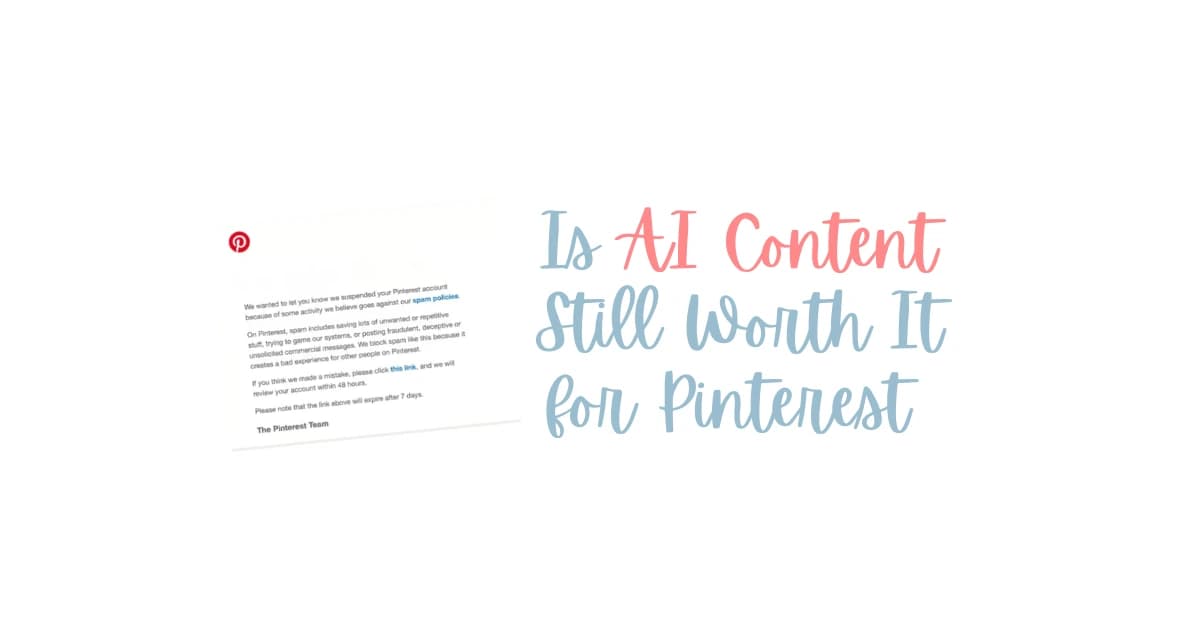
If you’ve been using AI to create content for your niche sites, you’ve probably seen people saying that Pinterest is killing AI sites and that this business model is no longer worth pursuing.
And honestly, I understand why people are worried.
I’ve seen traffic drops across different sites, and I know how frustrating it can be to watch your Pinterest traffic suddenly go down after you’ve spent so much time building your website and creating content.
But here’s my take: Pinterest didn’t kill AI sites. Low-quality content is the bigger problem.
There’s a huge difference between using AI to create content and publishing content that looks rushed, generic, or offers a poor experience to readers.
I’ve seen AI-powered sites continue to get traffic, while some websites with human-written content and real images have also experienced drops. Even among my own sites in the food niche, the results haven’t been the same.
So, does this mean AI content is dead on Pinterest? Not at all.
In this article, I’ll share my thoughts on the recent Pinterest traffic fluctuations, why some AI niche sites are struggling, what I think matters most when creating AI content, and how I approach the future of Pinterest marketing.
Did Pinterest Kill AI Sites?
Let’s answer the main question first.
No, I don’t think Pinterest killed AI sites.
There’s nothing inherently wrong with using AI to create blog content, generate images, or design Pinterest pins.
In fact, AI has become part of how many people create content today. You can use it to brainstorm ideas, write articles, generate images, and create pins much faster than doing everything manually.
And from what I’ve seen, plenty of websites using AI are still getting traffic and growing. Some of my own sites are still performing well, too.
So, when I see people claiming that AI sites are finished, I think they’re making a much bigger statement than the evidence from my own experience supports.
The real question isn’t whether you’re using AI.
It’s whether the content you’re creating is actually good.
Think about it. Two people can use AI to create content in the exact same niche, but their results can be completely different.
One person might publish generic articles with poor-looking images and pins that don’t stand out.
Another person might spend time improving their prompts, creating better visuals, researching keywords, and making sure their website provides a good experience.
Both are using AI, but the quality of their final content is not the same.
That’s why I don’t believe the right approach is to stop using AI just because some websites are losing traffic.
Instead, I think we need to understand what’s changing and focus on the things we can actually improve.
Why Low-Quality AI Content Is Struggling on Pinterest
In my opinion, low-quality content is a much bigger concern than AI itself.
When I talk about low-quality content, I’m referring to things like:
- Poor-looking Pinterest pins that don’t attract attention.
- Very thin blog articles that don’t provide enough value.
- Fake-looking or unrealistic AI-generated images.
- Generic articles that sound robotic and repetitive.
- Websites that provide a poor user experience.
The problem is that creating content with AI has become much easier.
You can generate an article, create a few images, design some pins, and publish everything without spending much time improving the final result.
But just because you can create content quickly doesn’t mean people will find it useful or engaging.
And that’s where I think many people go wrong.
They focus so much on producing more content that they forget about the quality of what they’re publishing.
Pinterest ultimately wants people to stay on the platform and engage with the content they see. From my perspective, it makes sense that content providing a better experience would have an advantage over content that looks rushed or low effort.
Imagine there are 50 pins targeting the same keyword.
Which one would you want to show to users if you were the algorithm?
Probably the one that provides the best experience.
Of course, I can’t control how Pinterest’s algorithm evaluates every pin or website. But I do believe that improving content quality is a much more useful direction than blaming AI itself.
AI can help you create content faster, but it doesn’t automatically make that content good.
And if your articles, images, and pins aren’t good enough, simply publishing more of them probably isn’t the solution.
How AI Prompts Affect Content Quality
One thing I think people underestimate is the importance of prompts.
They blame AI when the content they generate looks generic, but they don’t always consider how they’re instructing the AI to create that content in the first place.
Think about it.
If you give AI a vague prompt, you’re likely to get a generic article, an image that looks unrealistic, or content that doesn’t feel natural.
Then, if you publish that content without improving it, you end up with a website full of articles that don’t stand out.
But AI doesn’t have to be used that way.
With better prompts, you can work toward creating more natural articles, more realistic images, and content that offers a better experience for your readers.
For me, the goal isn’t simply to use AI to produce as much content as possible.
It’s to use AI in a way that helps me create better content while making the process more efficient.
Here are the areas where I think content creators should pay attention.
1. Create better AI-generated articles
Your articles shouldn’t feel like generic text that could have been published on hundreds of other websites.
The goal is to create content that addresses the topic properly and gives readers a good experience.
If your articles are too thin or feel robotic, I would focus on improving the prompts and the final content instead of simply producing more articles.
2. Improve your AI-generated images
Images matter, especially when you’re working in niches where people expect to see something realistic.
If your AI-generated images look fake or unnatural, that can affect how people perceive your content.
Better prompts can help you work toward more realistic visuals, but you still need to pay attention to the final result.
3. Focus on better Pinterest pins
Your pins are an important part of your Pinterest strategy.
If your pins look poor or fail to stand out, you’re making it harder for your content to attract attention.
I would rather focus on creating better-looking pins than publish more pins without considering their quality.
4. Think about the experience you’re creating
Your content doesn’t stop at the Pinterest pin.
People also need to have a good experience when they visit your website.
If the pin attracts attention but the article is disappointing, the overall experience isn’t great.
That’s why I think it’s important to look at the entire process, from the image and pin to the article and website itself.
AI is a tool that can help you create content. What matters is how you use it and what you ultimately publish.
Are AI Recipe Sites Still Worth It?
Let’s talk about food blogs because I know many people have noticed traffic drops in the AI food niche.
And honestly, I understand why this has created so much concern.
Food is one of those niches where authenticity matters. People often want to see real food, realistic images, and content that feels genuine.
If someone visits a recipe website and the images look obviously artificial, that may not create the experience they’re looking for.
But does that mean AI recipe sites are finished?
I don’t think so.
In my opinion, AI recipes can still work if the overall quality is good enough.
The important thing is not to assume that using AI automatically makes a recipe website unsuccessful.
I’ve also seen human-created websites with real images and real content lose traffic. So, based on what I’ve observed, the recent fluctuations don’t appear to affect only AI-powered food sites.
And this is an important distinction.
If both AI-generated and human-created websites are experiencing traffic drops, it doesn’t make sense to automatically conclude that AI is the only reason.
Of course, that doesn’t mean every website is affected in the same way or that content quality doesn’t matter.
It simply means that I wouldn’t make a decision about the entire AI food niche based on a few traffic drops.
My experience with food niche sites
One of my food niche sites experienced a drop, while another one continued performing completely fine.
Both are in the same general niche, but their results haven’t been identical.
This is one of the reasons I don’t believe we should immediately assume that Pinterest is targeting every AI food website.
Sometimes, websites experience fluctuations even when you’re putting effort into your content and trying to do things properly.
You can have two sites in the same niche and see very different results.
That’s why I prefer looking at what’s happening with each website instead of assuming that every traffic drop has the same explanation.
If you’re running an AI recipe site right now, I wouldn’t automatically abandon it just because other people are saying that the niche is dead.
I would look at the quality of the content, the pins, the images, and the overall website experience before making any major decisions.
Why Some Pinterest Sites Are Losing Traffic
There isn’t one single explanation I can confidently apply to every website that’s losing Pinterest traffic.
From what I’ve seen, traffic fluctuations can affect different types of websites, and not every site experiences the same results.
However, there are a few things I think are worth considering.
1. Your content may not be good enough
This is the first thing I would look at.
If your articles are thin, your images look fake, or your pins don’t stand out, there’s room to improve.
Using AI doesn’t automatically make these things better.
You still need to make sure that what you’re publishing provides a good experience.
2. The competition has increased
AI has made content creation faster, cheaper, and easier.
As a result, more people have entered the niche site business.
That means you’re no longer competing only against a small number of websites creating content around your chosen keywords.
More people can create articles and pins targeting the same topics, so standing out can become more difficult.
If everyone can produce content quickly, simply producing more content isn’t necessarily enough to give you an advantage.
3. Pinterest traffic naturally fluctuates
Another thing I think people need to understand is that Pinterest traffic doesn’t always remain consistent.
You might have days when your website gets plenty of traffic and other days when it gets much less.
Recently, the fluctuations I’ve observed have sometimes been stronger, which understandably makes people nervous.
But a temporary traffic drop doesn’t automatically mean your website has failed.
It also doesn’t automatically mean that Pinterest has decided to stop recommending AI content.
Organic traffic is something we can’t fully control. We can work on our content, improve our websites, and adjust our strategies, but we can’t guarantee how much traffic the algorithm will send us every day.
That’s why I wouldn’t judge the future of an entire business model based on a few bad days.
How Competition Is Changing the Pinterest Niche Site Business
I think increased competition is one of the biggest challenges for people building niche sites with AI.
Previously, creating a large amount of content required more time and effort.
Now, AI can help people produce articles, images, and pins much faster.
This is great if you’re using AI to improve your workflow, but it also means more people can enter the same business model.
And when more people start targeting the same keywords, standing out becomes more difficult.
Imagine 50 different pins targeting the same search term.
They might all be relevant to the keyword, but they won’t all provide the same experience.
Some may have better designs, some may look more realistic, and some may lead to more useful articles.
If you’re competing against all of these pins, you need to give people a reason to engage with yours.
This is why I believe the strategy needs to go beyond simply creating more content.
You need to pay attention to:
- Keyword research: Target the keywords that make sense for your content strategy.
- Pinterest pin quality: Create pins that look good and stand out.
- Website speed: Make sure your site provides a smooth experience.
- User experience: Give visitors a reason to stay and engage with your content.
- Content quality: Publish articles that are useful rather than thin or generic.
These things become even more important when more people can produce content quickly.
AI has made content creation easier, but that doesn’t mean building a successful niche site has become effortless.
If anything, I think the increased competition makes it more important to focus on the quality of your work.
What to Focus on When Growing an AI Pinterest Site
If you’re currently building an AI-powered niche site, I wouldn’t spend all your time worrying about whether AI is dead.
Instead, I would focus on improving the parts of your business that you can control.
Here are the areas I would prioritize.
1. Improve your keyword research
Creating content around keywords is one thing. Creating content that fits your strategy and gives you a chance to stand out is another.
When competition increases, I think it’s important to pay more attention to your keyword research rather than simply creating articles without a clear direction.
Your content and pins should be built around the keywords you’re targeting.
2. Make your Pinterest pins better
Don’t underestimate the importance of your pin designs.
If your pins look generic or poorly designed, they’re unlikely to stand out as much as stronger alternatives targeting the same keyword.
Focus on improving how your pins look instead of assuming that publishing more of them will automatically solve your traffic problems.
3. Improve the quality of your articles
Take a closer look at the articles you’re publishing.
Are they too thin? Do they feel robotic? Do they provide a good experience for the reader?
If the answer is yes, that’s where I would focus my efforts.
Better prompts can help you generate better content, but the final article still needs to meet your quality expectations.
4. Pay attention to website speed and user experience
Your Pinterest strategy shouldn’t focus only on getting people to click on your pins.
You also need to think about what happens after someone visits your website.
A better overall experience is an important part of building a website that people want to use.
That’s why I would consider website speed and user experience alongside keyword research, pins, and articles.
5. Use AI to improve your workflow, not replace quality
I still see AI as a useful way to create content more efficiently.
It can help with ideas, articles, images, and pins.
But I wouldn’t treat AI as a reason to skip the work needed to make your content good.
The goal is to use it to create better content more efficiently, not to publish as much as possible without considering the result.
6. Stay consistent and keep improving
Building a niche site takes time, and traffic won’t necessarily increase every single day.
If you experience a temporary drop, don’t immediately assume that your entire strategy has stopped working.
Look at what you can improve and continue working on the quality of your website.
Consistency doesn’t mean ignoring problems. It means continuing to work toward your goals instead of making drastic decisions every time your traffic fluctuates.
Should You Delete Your Content After a Pinterest Traffic Drop?
Personally, I think people can be too quick to panic when they see their traffic going down.
A few days of lower traffic can be enough for some website owners to start questioning everything.
They delete content, switch niches, and completely change their strategies because they believe their current business model is finished.
But I don’t think a temporary traffic drop is enough, by itself, to justify making such drastic changes.
Pinterest traffic has always fluctuated, and the fluctuations I’ve seen recently have sometimes been stronger.
That doesn’t mean every drop is temporary or that every website will recover. I can’t promise that.
However, I also wouldn’t assume that a website is finished simply because traffic has declined for a few days or a week.
Before making a major decision, I would take a closer look at the website itself.
Ask yourself:
- Is the content actually low quality?
- Do the Pinterest pins need improvement?
- Are the articles too thin or generic?
- Is the website providing a good user experience?
- Am I reacting to a short-term fluctuation rather than looking at the bigger picture?
These questions can help you focus on the areas where you may have room to improve.
If you identify genuine quality problems, work on fixing them.
But if your only reason for abandoning a website is that Pinterest traffic has dropped temporarily, I would think carefully before giving up on the entire project.
Don’t confuse a traffic fluctuation with proof that your business model is dead.
What Is the Future of AI Content on Pinterest?
My prediction is that we’ll probably see more AI-powered niche sites in the future, not fewer.
AI makes it easier for people to create content, so I don’t expect everyone to suddenly stop using it.
However, I think the quality of that content will become an increasingly important factor in determining which websites can stand out.
As more people enter the same niches, low-quality websites may struggle to compete.
Some people will become discouraged when they don’t get the results they expected and eventually quit.
Meanwhile, people who focus on improving their content and remain consistent may continue to find opportunities.
That’s how I see the future of Pinterest niche sites.
I don’t think the answer is to avoid AI completely.
I think the better approach is to understand how to use it properly.
If you’re using AI to create thin articles, unrealistic images, and generic pins, you have a quality problem to address.
But if you’re using AI to help create better content, improving your keyword research, and focusing on the overall experience of your website, I don’t see a reason to assume that your business model is automatically finished.
There will always be changes, competition, and traffic fluctuations that you can’t fully control.
What you can control is the quality of the work you’re putting into your website.
And that’s where I would put my attention.
Frequently Asked Questions About Pinterest and AI Sites
Did Pinterest kill AI sites?
No, I don’t believe AI sites are dead. I’ve seen AI-powered websites continue to get traffic, while some human-created websites have also experienced traffic drops. In my opinion, the bigger issue is low-quality content rather than AI itself.
Can AI-generated content still work on Pinterest?
Yes, I believe AI-generated content can still work when the overall quality is good. The important thing is to focus on useful articles, realistic images, well-designed pins, and a good website experience instead of simply publishing content as quickly as possible.
Why are AI recipe sites losing Pinterest traffic?
I’ve observed traffic drops in the food niche, but I’ve also seen human-created websites with real images and content experience declines. One of my food sites dropped while another continued performing well. Based on my experience, I wouldn’t automatically attribute every traffic drop to AI.
Is AI-generated content the reason my Pinterest traffic dropped?
Not necessarily. A traffic drop alone doesn’t prove that AI is the reason. Traffic fluctuations can affect different websites, and I wouldn’t assume that every decline has the same explanation. It’s worth looking at your content quality, pins, website speed, and user experience before making major changes.
Should I stop using AI for my niche site?
I wouldn’t stop using AI simply because people are saying that AI sites are finished. I would focus on how you’re using it. Better prompts, better articles, more realistic images, and stronger pins can help you improve the quality of your content.
What should I improve first if my Pinterest traffic is declining?
I would start by reviewing the quality of your content and the overall experience you’re providing. Look at your articles, pins, images, keyword research, website speed, and user experience. The right priorities will depend on what needs improvement on your particular site.
Is it still worth building an AI niche site?
In my opinion, there is still an opportunity for people who focus on quality and remain consistent. However, AI has made content creation easier, which means more people are competing in the same niches. Simply publishing more content isn’t necessarily enough to stand out.
Final Thoughts
So, did Pinterest kill AI sites?
No. I believe low-quality content is the bigger problem.
AI is still a useful tool for creating articles, generating images, designing pins, and making the content creation process more efficient.
But the fact that you can create content quickly doesn’t mean you should publish everything without paying attention to quality.
The competition is getting stronger, and I think standing out requires more than simply using AI to produce a large amount of content.
You need better keyword research, better pins, better articles, realistic images, and a website that provides a good experience.
And if your Pinterest traffic suddenly drops, don’t automatically assume that your entire business model is finished.
Traffic fluctuations happen, and different websites can experience very different results. Take the time to understand what’s happening with your own site before making drastic changes.
For me, the future of Pinterest niche sites isn’t about choosing between AI and human-created content.
It’s about learning how to create better content, using the tools available to you, and staying consistent even when things don’t go exactly as planned.
AI Pinterest isn’t dead. But if you want to stand out, quality matters more than ever.