
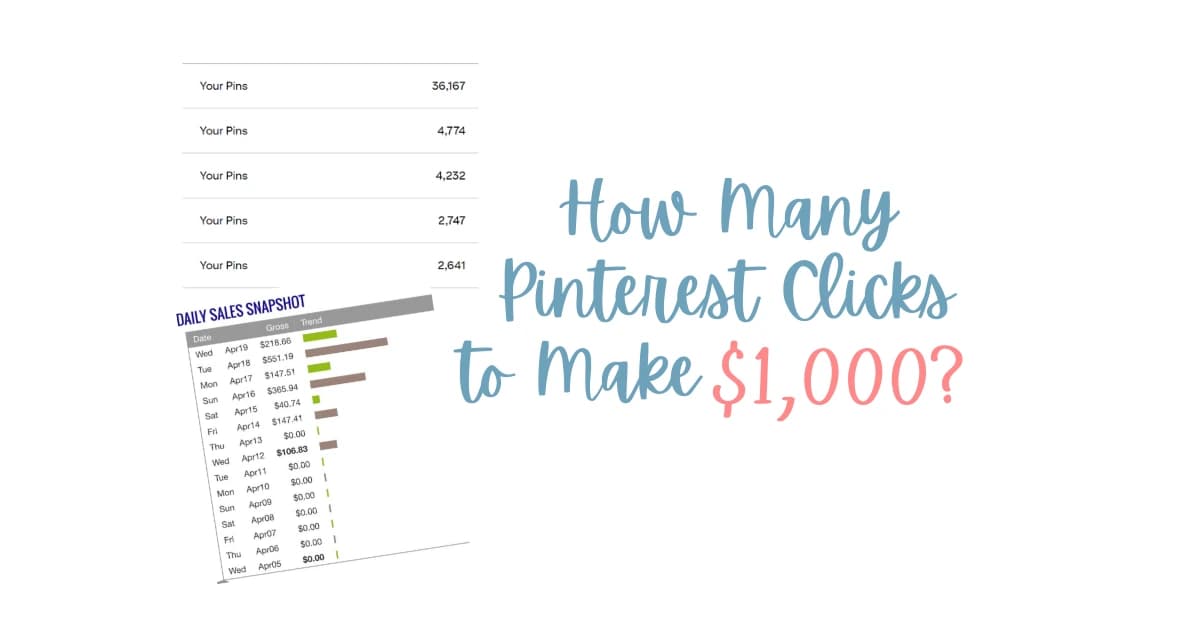
Have you ever wondered how many Pinterest clicks you actually need to make $1,000 a month from your blog?
When I first look at Pinterest income, I think it’s easy to get caught up in traffic numbers. We see bloggers getting thousands of clicks every month, and naturally, we start wondering how much money that traffic could make.
But here’s something interesting.
One website can need around 78,000 monthly sessions to make $1,000, while another can reach the same income with fewer than 10,000 sessions.
Same Pinterest platform. Same goal. Completely different traffic requirements.
So, what’s the difference?
It’s not necessarily how many pins you create or how much traffic Pinterest sends to your website. A big part of the answer comes down to how you monetize your blog and how much each visitor is worth.
In this guide, I’ll break down how many Pinterest clicks you need to make $1,000 a month, how blog ad revenue works, how to calculate your traffic goals, and how digital products can help you earn more from the traffic you already have.
How Many Pinterest Clicks Do You Need to Make $1,000 a Month?
The number of Pinterest clicks you need depends on how much money your website makes from each visitor.
If you’re relying entirely on display ads, you may need tens of thousands of monthly sessions to reach $1,000. However, if you sell a digital product that matches your audience’s needs, you could reach that same income with significantly less traffic.
Here’s a quick comparison based on the examples I’ll explain throughout this article.
| Monetization strategy | Approximate monthly sessions needed |
| Display ads at a $12.69 RPM | 78,000–79,000 |
| Display ads at a $20 RPM | 50,000 |
| Ads + a $9 printable | 15,000–16,000 |
| Ads + a $19 printable | 9,000 |
| A $99 digital product | Around 5,000 sessions at the example conversion rate |
These numbers are based on different monetization scenarios, so they’re not directly interchangeable. The last example also assumes a highly targeted audience and a specific product conversion rate.
The important thing to understand is that there isn’t one universal Pinterest traffic target for making $1,000 a month.
Your target depends on the revenue you generate from each website session.
Let’s start with the simplest way to calculate it.
What Is RPM in Blog Monetization?
If you want to understand how much traffic you need to make money blogging, you need to understand RPM.
RPM stands for revenue per thousand sessions in the context of the examples in this article.
In simple terms, it tells you how much money your website earns for every 1,000 sessions.
A session represents a visit to your website. It isn’t the same as a page view, and it isn’t the same as a Pinterest click.
This distinction matters because Pinterest traffic doesn’t automatically translate into website sessions.
How to calculate your blog income using RPM
The formula is straightforward:
Monthly revenue = (Monthly sessions ÷ 1,000) × RPM
For example, let’s say your blog receives 50,000 sessions per month and your RPM is $20.
Your calculation would look like this:
50,000 ÷ 1,000 = 50
50 × $20 = $1,000
That means your blog could generate $1,000 in monthly ad revenue at that traffic level and RPM.
Now, let’s say your website only receives 10,000 sessions per month.
10,000 ÷ 1,000 = 10
10 × $20 = $200
At the same RPM, you’d make approximately $200 a month from ads.
See how simple it is?
Once you understand this calculation, you can work backward from your income goal to figure out how many sessions you need.
But there’s one important limitation: this formula only calculates the revenue you’re earning from the RPM included in the calculation. If you also sell digital products or earn money through other monetization methods, your total income can be different.
How Much Traffic Do You Need Based on Your Ad RPM?
Let’s look at two different ad revenue scenarios to see why your RPM makes such a big difference.
Scenario 1: Making $1,000 a month at a $12.69 RPM
One publisher reported an average RPM of $12.69 across their first 90 days on Journey by Mediavine.
Using that RPM, here’s how much traffic you would need to make $1,000 a month.
$1,000 ÷ $12.69 × 1,000 = approximately 78,800 sessions.
That means you’d need around 78,000–79,000 monthly sessions to reach your $1,000 income goal from ads alone.
If you’re currently receiving only a few hundred sessions a month from Pinterest, that number can feel pretty overwhelming.
I get why. Looking at the gap between your current traffic and almost 79,000 sessions can make the goal seem much further away than you’d like.
But this is only one monetization scenario.
Scenario 2: Making $1,000 a month at a $20 RPM
Now, let’s look at a blog earning $20 per thousand sessions.
The calculation becomes:
$1,000 ÷ $20 × 1,000 = 50,000 sessions.
Instead of needing almost 79,000 sessions, you would need 50,000 monthly sessions.
That’s a considerable difference, even though both websites are aiming for the same monthly income.
And this brings me to something I want you to remember: traffic is only one part of your income equation.
Your RPM matters, too.
However, there’s still another number you need to understand before setting your Pinterest traffic goal.
Website sessions and Pinterest clicks are not the same thing.
Why Pinterest Clicks Are Not the Same as Website Sessions
This is where I think many bloggers can miscalculate how much Pinterest traffic they need.
When you look at your Pinterest analytics, you might see thousands of outbound clicks. It’s tempting to assume every click becomes a website visit.
Unfortunately, that isn’t always what happens.
Someone can click your pin, open the link, and leave before your website finishes loading. The visit may never become a completed website session.
In the example we’re using, roughly one-fifth of Pinterest clicks don’t turn into sessions.
Let’s say your goal is 50,000 website sessions a month.
If approximately 80% of your Pinterest clicks become sessions, you’d need around 62,500 outbound clicks to generate those 50,000 sessions.
Here’s the calculation:
50,000 ÷ 0.80 = 62,500 clicks.
Now, let’s break that down into a daily target.
62,500 ÷ 30 = approximately 2,083 clicks per day.
So, you’d need around 2,000–2,100 Pinterest outbound clicks per day to generate 50,000 monthly sessions under this example.
That’s the number to keep in mind if your blog earns around $20 per thousand sessions and you rely entirely on ads.
But I wouldn’t stop here.
Why? Because this calculation assumes your only way to monetize your website is by showing advertisements.
What if you could make more money from the same traffic?
That’s where things get interesting.
Blog Ad Network Requirements in 2026
Before you build your entire Pinterest strategy around display ads, it’s worth understanding the entry requirements discussed for different ad networks in 2026.
These requirements matter because you need to qualify for an ad network before you can earn through it.
Here’s the breakdown from the figures I’m using in this guide.
| Ad network | Requirement described for 2026 |
| Journey by Mediavine | Starts at 1,000 sessions per month |
| Ezoic | A new-publisher requirement of 250,000 monthly users, with existing sites grandfathered in |
| Mediavine | $5,000 in ad revenue over 12 months |
| Raptive | Starts at 25,000 page views |
Notice something?
The requirements aren’t all based on the same metric.
Some refer to sessions, one refers to monthly users, another is based on revenue, and another uses page views. These numbers shouldn’t be treated as interchangeable.
The key takeaway is that you don’t necessarily need the same amount of traffic to qualify for every ad network.
If you’re starting a blog and want to monetize with display ads, the first milestone in this example is 1,000 monthly sessions.
That gives you a smaller initial target to work toward instead of focusing only on the tens of thousands of sessions you might eventually need for $1,000 in monthly ad revenue.
But I also want you to think beyond ad networks.
Getting approved for ads is one milestone. Building a blog that earns $1,000 a month is another.
And the way you monetize your content can make a significant difference between the two.
How to Make $1,000 a Month With Fewer Pinterest Clicks
Here’s the part I find most interesting.
What if you could keep the same blog content, the same pins, and the same amount of traffic but increase the amount of money you earn from each visitor?
That’s the idea behind combining display ads with your own digital products.
Instead of depending entirely on ad revenue, you give readers the option to purchase something that helps them solve the problem they came to your website to learn about.
Let’s use a simple example.
Imagine you have a blog post that receives Pinterest traffic and earns $20 per thousand sessions from display ads.
At 50,000 monthly sessions, you’d make approximately $1,000 from ads.
Now, imagine you add a $9 printable to that same website.
The printable is relevant to the content your audience is already reading.
For this example, let’s assume one person out of every 200 website sessions buys your product.
That’s a 0.5% conversion rate.
Here’s what happens.
Step 1: Calculate your digital product revenue
For every 1,000 sessions, one sale per 200 sessions would give you five sales.
Five sales × $9 = $45.
So, your $9 printable generates $45 for every 1,000 sessions under this example.
Step 2: Add your display ad revenue
Your website is already earning $20 per thousand sessions from ads.
Now you have:
- Display ad revenue: $20
- Digital product revenue: $45
- Total revenue: $65 per 1,000 sessions
Instead of making $20 per thousand sessions, you’re generating $65 from the same amount of traffic.
Step 3: Calculate how many sessions you need to make $1,000
Now let’s work backward again.
$1,000 ÷ $65 × 1,000 = approximately 15,385 sessions.
That means you’d need around 15,000–16,000 monthly sessions to generate $1,000 in combined ad and digital product revenue under these assumptions.
Compare that with the 50,000 sessions required when you’re relying on a $20 ad RPM alone.
You can see why monetization matters so much.
You don’t always need more traffic. Sometimes, you need to make more money from the traffic you already have.
Of course, these calculations are examples, not guaranteed earnings. Your actual results will depend on your product, audience, conversion rate, and ad revenue.
But the principle is worth understanding before you spend all your time chasing more Pinterest clicks.
How Much Traffic Do You Need to Make $1,000 With a $19 Printable?
Let’s take the same strategy a step further.
Instead of selling a $9 printable, imagine you sell a $19 printable.
We’ll keep the same example conversion rate of one sale for every 200 sessions.
For every 1,000 sessions, you’d make five sales.
Five sales × $19 = $95.
Now add your $20 in display ad revenue.
Your total becomes:
$95 + $20 = $115 per 1,000 sessions.
To calculate the number of sessions needed to make $1,000:
$1,000 ÷ $115 × 1,000 = approximately 8,696 sessions.
In other words, you’d need around 9,000 monthly sessions to reach your $1,000 goal under this scenario.
Let’s compare the three models.
| Monetization model | Revenue per 1,000 sessions | Sessions needed for $1,000 |
| Ads at $20 RPM | $20 | 50,000 |
| Ads + $9 printable | $65 | About 15,385 |
| Ads + $19 printable | $115 | About 8,696 |
The difference is huge.
Your website doesn’t necessarily need more visitors to earn more money. Instead, you can improve how much revenue each visitor generates.
And because your pins send people to your blog content, improving the monetization of that content can make the traffic you’re already working to build more valuable.
Can a Small Blog Make More Money Than a High-Traffic Blog?
Yes, it’s possible under the examples we’re discussing.
Let’s compare two websites.
Website A: Ads only
This website receives 50,000 monthly sessions and earns a $20 RPM.
Its monthly ad revenue is approximately $1,000.
Website B: A targeted audience and a digital product
This website receives fewer visitors but sells a $99 digital product.
Let’s assume one person out of every 500 sessions buys the product.
For every 1,000 sessions, that’s two sales.
Two sales × $99 = $198.
That’s approximately $198 in product revenue per thousand sessions, before considering any other income.
Under these assumptions, the product revenue per thousand sessions is almost ten times the $20 ad RPM used in the first example.
This is why a website receiving 5,000 monthly sessions can potentially earn more than a website receiving 50,000 sessions.
But there’s an important condition.
You can’t simply put a $99 product on any website and expect people to buy it.
The offer needs to match the audience.
If someone arrives at your blog searching for an answer to a very specific problem, a relevant product that helps solve that problem may be valuable to them.
That’s different from selling something unrelated to the reason they clicked your pin.
The more closely your content, audience, and offer align, the more sense the product makes.
This is also why I wouldn’t judge a blog’s earning potential by traffic alone.
A website with 20,000 monthly clicks and no product to sell could earn less than a website with 5,000 clicks and one relevant offer.
Your traffic matters, but so does what happens after the visitor arrives.
Why a Targeted Audience Matters More Than Traffic
Let’s say two bloggers are using Pinterest to drive traffic to their websites.
Both want to make $1,000 a month.
One blogger creates content that attracts a broad audience and relies entirely on display ads.
The other creates content around a specific problem and offers a relevant digital product.
Even if the second blogger receives fewer visits, each visit may be worth more because there’s a clear connection between what the reader wants and what the blogger sells.
That’s the strategy I would focus on.
Instead of asking only, “How can I get more Pinterest clicks?” ask yourself these questions:
- What problem is the reader trying to solve when they click my pin?
- Does my blog post answer that question?
- Is there a digital product that naturally fits the content?
- Would the reader find that product useful?
- How much revenue could that offer generate per thousand sessions?
You don’t need to turn every blog post into a sales page.
The point is to understand the intent behind your traffic and make sure your monetization strategy fits that intent.
For example, if your post attracts readers who are looking for a specific printable, template, or resource, a relevant product could be a natural fit.
If the content doesn’t connect to a product, display ads may be the primary monetization method in your example.
The important thing is to make the decision intentionally rather than assuming every blog needs the same amount of traffic to succeed.
When Should You Start Monetizing Your Blog?
Now, I don’t want you to misunderstand this strategy.
I’m not saying you should ignore traffic and focus entirely on selling products from day one.
You need people visiting your website before you can earn from those visits.
So, I would approach the process in stages.
Stage 1: Focus on getting your first 1,000 monthly sessions
Your first milestone is to build traffic.
At this stage, you’re working toward getting people from Pinterest to your website and building a foundation for monetization.
If you’re starting from zero, don’t let the 50,000-session target discourage you.
Your first goal is much smaller.
Work toward your first 1,000 sessions, then continue building from there.
Stage 2: Work toward your first monetization milestone
Once you have around 1,000 monthly sessions, you can consider the ad network entry point described for Journey by Mediavine in this guide.
Remember that reaching a traffic threshold doesn’t automatically mean your website will be approved. The relevant network’s requirements still apply.
The idea is to begin building your monetization strategy while your traffic continues growing.
Stage 3: Start developing your offer around 5,000 monthly sessions
At around 5,000 monthly sessions, I would start paying more attention to what I could sell to my audience.
You don’t have to wait until you reach 50,000 sessions before thinking about digital products.
Instead, you can work on creating a relevant offer while continuing to grow your Pinterest traffic.
Why does this matter?
Because improving your monetization earlier means that the additional traffic you receive later can benefit from the same improvements.
If you wait until you have tens of thousands of sessions before considering an offer, you may spend more time relying entirely on display ads than you need to.
Your traffic strategy and monetization strategy can develop together.
Stage 4: Keep improving the value of each visit
As your traffic grows, continue thinking about what each thousand sessions is worth.
If your blog earns $20 per thousand sessions, you know how much traffic you need to reach $1,000 from ads.
If your combined ad and product revenue reaches $65 or $115 per thousand sessions under the examples above, your required traffic target becomes much lower.
This doesn’t mean you can guarantee a particular income.
It means you have another part of the equation to work on instead of focusing exclusively on getting more clicks.
My Pinterest Blog Monetization Strategy
If I were organizing this entire strategy into a practical plan, I would keep it simple.
1. Start with traffic, not perfection
Your website needs visitors before it can generate revenue.
I would focus on building Pinterest traffic and working toward the first 1,000 monthly sessions.
Rather than getting discouraged by the number of clicks other bloggers receive, I would concentrate on growing my own traffic consistently.
2. Understand the difference between clicks and sessions
I would track Pinterest outbound clicks separately from website sessions.
A click doesn’t automatically mean a session, so I wouldn’t use my Pinterest click count as a direct substitute for my website traffic.
This distinction helps me calculate a more realistic traffic target.
3. Calculate my ad revenue potential
Once I know my sessions and RPM, I can estimate how much my blog might earn from display ads.
The formula is simple:
Monthly sessions ÷ 1,000 × RPM = monthly ad revenue.
This tells me how much traffic I’d need if I continued relying on ads alone.
4. Look for a relevant digital product
Next, I’d look at the content I’m already creating.
Is there a printable, template, or other digital product that fits the problem my audience is trying to solve?
If there is, I’d consider how it could complement my existing content.
I wouldn’t create a product simply because I want to make more money. I’d focus on whether the product makes sense for the people arriving on my website.
5. Calculate the value of my offer
Before setting a traffic goal, I’d calculate what the product could generate at a few different conversion rates and prices.
For example, the scenarios in this article show how the numbers change when the offer moves from $9 to $19 or $99.
These calculations help me understand the relationship between product pricing, conversion rates, and required traffic.
6. Build my monetization strategy before traffic gets too big
I wouldn’t necessarily wait until I had 50,000 monthly sessions to think about monetization.
I’d start considering my offer around the 5,000-session milestone while continuing to grow my traffic.
That way, I’m working on both parts of the business instead of assuming that more Pinterest clicks will automatically solve every income problem.
7. Keep asking what each 1,000 visits is worth
This is the question that brings everything together.
Instead of focusing only on the number of clicks Pinterest sends me, I’d look at how much revenue my website generates per thousand sessions.
If that number increases, the amount of traffic I need to reach my income goal can decrease.
That’s the bigger opportunity.
You can keep working on your Pinterest traffic while also improving the way you monetize your website.
And you don’t have to rely on one strategy alone.
Frequently Asked Questions
How many Pinterest clicks do I need to make $1,000 a month?
It depends on your website’s RPM and how you monetize your content.
At a $20 ad RPM, you’d need 50,000 monthly sessions to earn $1,000 from ads alone. If approximately 80% of Pinterest clicks become sessions, that’s around 62,500 outbound clicks.
If you combine ads with a relevant digital product, your required traffic could be much lower under the conversion assumptions used in this article.
Can I make $1,000 a month from Pinterest with 10,000 clicks?
It’s possible under certain monetization scenarios, but 10,000 clicks alone don’t determine your income.
You need to consider how many clicks become website sessions, your ad RPM, and whether you sell products or use other monetization methods.
For example, a website earning $115 per thousand sessions from ads and a $19 printable would need around 8,700 sessions to generate $1,000 in combined revenue under the assumptions discussed above.
That doesn’t mean 10,000 Pinterest clicks will automatically produce those sessions or earnings.
How many website sessions do I need to make $1,000 a month from ads?
The answer depends on your RPM.
At a $12.69 RPM, you’d need approximately 78,800 sessions. At a $20 RPM, you’d need 50,000 sessions.
Use this formula to calculate your own target:
Required sessions = ($1,000 ÷ RPM) × 1,000
This calculation assumes the income comes entirely from the ad revenue represented by that RPM.
What is the difference between Pinterest clicks and blog sessions?
Pinterest clicks measure people clicking through from your pins. Website sessions measure visits to your website.
Some people click a pin but leave before the page finishes loading, so the click may not become a completed session.
That’s why you should calculate your income goals using website sessions when working with an RPM based on sessions.
Can I make more money with fewer Pinterest clicks?
Yes, it’s possible if you increase the revenue generated by each website session.
Display ads are one way to monetize traffic. Selling a relevant digital product can provide another revenue stream.
In the examples in this article, adding a $9 or $19 printable to a website earning $20 per thousand sessions from ads substantially reduces the number of sessions needed to reach $1,000 in combined revenue.
Your actual results will depend on your audience, offer, conversion rate, and ad earnings.
Should I focus on Pinterest traffic or digital products first?
I would start by building traffic because you need visitors before you can generate revenue.
However, I wouldn’t necessarily wait until my website receives 50,000 sessions before thinking about digital products.
Working on a relevant offer around the 5,000-session milestone allows you to develop your monetization strategy while your traffic continues growing.
Can a blog with 5,000 monthly sessions make $1,000 a month?
It can be possible with the right monetization model, but it isn’t guaranteed.
For example, a $99 digital product selling once for every 500 sessions generates approximately $198 per thousand sessions in product revenue.
At 5,000 sessions, that would amount to about $990 in product revenue under those assumptions, before considering any other income or expenses.
The example depends on achieving the assumed conversion rate with a highly targeted audience.
Final Thoughts
So, how many Pinterest clicks do you need to make $1,000 a month?
If you’re relying entirely on display ads, you may need around 62,500 Pinterest outbound clicks to generate 50,000 website sessions at the conversion assumption used in this article.
But that’s not the only way to approach your income goal.
You can also work on increasing the amount of money your website generates from each visitor by combining display ads with relevant digital products.
As we’ve seen, a $9 printable or a $19 printable can change the traffic calculation significantly under the same conversion assumptions. A higher-priced product can change it even more when the audience is a good match.
That’s why I wouldn’t focus on Pinterest clicks alone.
I would focus on building traffic, understanding my RPM, and creating an offer that makes sense for the people who visit my website.
Start with your first 1,000 monthly sessions. As your traffic grows, begin working on your monetization strategy. Then keep improving the value of each visit instead of assuming that the only way to earn more is to get more clicks.
Because the real question isn’t just how much traffic you need to make $1,000 a month. It’s how much your traffic is worth—and what you can do to make it worth more.