
If you’re using Pinterest to drive traffic to your blog, you’ve probably wondered how much money you could make from display ads.
And honestly, choosing the right ad network can feel confusing.
You have Google AdSense, Journey by Mediavine, Mediavine, Monumetric, Raptive, and Ezoic. They all help you monetize your website, but their traffic requirements, approval criteria, and earning potential are not the same.
Here’s the thing: getting more Pinterest traffic is only one part of growing your blog income. You also need to understand how to monetize that traffic.
Two blogs can receive similar amounts of traffic and earn very different amounts from display ads. Why? Because your niche, audience location, ad placements, and ad network can all influence your earnings.
So, which ad network should you choose if most of your blog traffic comes from Pinterest?
In this guide, I’ll break down the main differences between AdSense, Journey by Mediavine, Ezoic, Mediavine, Monumetric, and Raptive. You’ll learn their traffic requirements, what to consider before applying, how RPM works, and which option makes the most sense at different stages of your blogging journey.
I’ll also share why I believe display ads shouldn’t be your only monetization strategy if you want to build a sustainable blog business.
Quick Comparison: Best Ad Networks for Pinterest Bloggers
Before getting into the details, here’s a quick comparison of the six ad networks and their entry requirements covered in this guide.
| Ad network | Traffic or revenue requirement | Best starting point |
| Google AdSense | No minimum traffic requirement | New blogs |
| Journey by Mediavine | 1,000 sessions in 30 days | Growing blogs |
| Ezoic | 250,000 monthly active users for new applicants under the requirements discussed here | Established, high-traffic blogs |
| Monumetric Propel | 10,000–80,000 monthly pageviews | Growing blogs |
| Raptive | 25,000 monthly pageviews | Blogs meeting its audience and content criteria |
| Mediavine | $5,000 in annual ad revenue | Blogs already generating substantial ad income |
Important: These networks measure different things. Sessions, pageviews, monthly active users, and annual ad revenue aren’t interchangeable, so make sure you’re comparing the correct metric when evaluating your eligibility.
Also, meeting a traffic threshold doesn’t automatically guarantee acceptance. Each network has additional criteria to consider.
Now, let’s look at what each option offers and how to decide which one fits your Pinterest blog.
How Do Display Ads Make Money?
Before choosing an ad network, it helps to understand how display advertising works.
When someone visits your blog, ads can appear within your content, in your sidebar, or in other placements on your website. The ad network connects your website with advertisers and manages the advertising system.
In return, you earn revenue from the ads displayed to your readers.
One of the main metrics you’ll come across is RPM, or revenue per thousand impressions or sessions, depending on how the network defines and reports it.
Think of an ad network as the broker between your website and advertisers.
Your content attracts readers, and your ad network helps monetize their attention. However, not every network delivers the same advertising demand, technology, or ad placements.
That’s why choosing an ad network deserves more thought than simply signing up for whichever one accepts your application first.
Your goal should be to find the right monetization option for your blog’s current stage while continuing to grow your traffic.
1. Google AdSense: Best for New Pinterest Blogs
If you’re just starting your blogging journey, Google AdSense is one of the first options to consider.
The biggest advantage? There is no minimum traffic requirement.
You don’t need to wait until your Pinterest account sends thousands of visitors to your website before you can apply.
A new blog can potentially get approved if its content meets the relevant requirements.
Why I would consider AdSense first
When you’re building a blog from scratch, you have plenty to focus on already.
You’re creating content, researching keywords, designing Pinterest pins, and trying to bring your first visitors to your website.
AdSense gives you an opportunity to start monetizing while you’re still working toward the traffic requirements of other networks.
It also gives you an early opportunity to learn how display advertising works and how your traffic translates into revenue.
However, there’s one important trade-off.
AdSense generally pays less than the premium ad networks discussed in this guide. So, while it can be a reasonable starting point, I wouldn’t automatically assume it’s the best long-term option once your blog grows.
What about AI-generated content?
Content quality matters.
Using AI to produce large numbers of pages without adding meaningful value can create problems with Google’s publisher and spam policies.
Rather than focusing on publishing as much content as possible, prioritize useful, original articles that genuinely help your readers.
Is AdSense worth it for Pinterest traffic?
Yes, it can be a starting point if your blog is new and you want to begin monetizing without a minimum traffic threshold.
But as your Pinterest traffic grows, it’s worth comparing other networks and evaluating whether your current setup is still the right fit.
My takeaway: Start with AdSense if it makes sense for your stage, but don’t assume you need to stay there forever.
2. Journey by Mediavine: Best for Growing Pinterest Blogs
Journey by Mediavine is an interesting option for bloggers who are starting to get consistent traffic but aren’t ready for Mediavine’s main program.
The requirement covered in this guide is 1,000 sessions within 30 days.
Yes, just 1,000 sessions!
This makes Journey a potential next step for bloggers who have moved beyond the very beginning of their blogging journey.
Why Journey is worth considering
Journey is Mediavine’s entry-level program. It provides access to its advertising technology and demand without requiring the same revenue level as the main Mediavine program.
For Pinterest bloggers, this can be an appealing milestone to work toward.
Instead of waiting until your website becomes a large publication, you can start evaluating premium advertising earlier in your growth journey.
What do you need before applying?
There are two important things to understand.
First, Journey requires you to install its Grow plugin.
Second, Journey requires exclusivity for programmatic advertising.
In practical terms, you cannot run another display ad network alongside Journey if doing so violates its exclusivity requirements.
This matters because joining a network isn’t simply about adding another way to earn money. It can affect how you manage advertising across your entire website.
Is Journey good for Pinterest traffic?
It can be a strong option to consider once your blog reaches the required sessions.
However, don’t assume that every website will earn the same amount just because it reaches the same traffic level.
Your niche, audience location, ad placements, and engagement all influence how much revenue your traffic can generate.
My takeaway: If you’re growing through Pinterest and your blog reaches 1,000 sessions in 30 days, Journey is one of the first premium advertising options I’d investigate.
3. Ezoic: What Pinterest Bloggers Need to Know
Ezoic is another name bloggers may encounter when comparing display ad networks.
However, its eligibility requirements deserve special attention because older articles may refer to different thresholds.
Under the requirements covered in this guide, Ezoic requires 250,000 monthly active users for new applicants, effective February 19, 2026.
That’s monthly active users, not sessions or pageviews.
Those metrics measure different things, so don’t assume that reaching 250,000 pageviews automatically means you’ve met the requirement.
What if you’re already using Ezoic?
The rules discussed here include a grandfathering provision for publishers who were already using Ezoic before February 19, 2026.
Those publishers retain their existing status regardless of their current size, subject to the stated conditions.
However, there’s an important detail: if you remove the Ezoic integration for more than seven days, you lose that grandfathered status. To return, you must meet the full 250,000 monthly active user requirement.
This is particularly important if you’re thinking about experimenting with another advertising network.
Before removing an existing integration, understand what that decision could mean for your eligibility.
Should a new Pinterest blogger focus on Ezoic?
Based on the requirements outlined here, I wouldn’t make Ezoic the immediate milestone for a small or growing blog.
If you’re still working toward your first few thousand sessions, it makes more sense to evaluate networks whose entry requirements align with your current traffic.
My takeaway: Always distinguish between current eligibility rules and older information when comparing ad networks. A threshold based on monthly active users is not the same as one based on pageviews.
4. Monumetric: A Potential Bridge for Growing Blogs
Monumetric is another option to consider as your blog grows.
Its entry-level tier is called Propel, and it covers websites receiving 10,000 to 80,000 pageviews per month.
For bloggers who have outgrown their initial monetization setup but aren’t yet generating enough revenue for Mediavine’s main program, this can be a useful stage to evaluate.
Monumetric’s Propel program
Here are the main details to know:
- Traffic requirement: 10,000–80,000 monthly pageviews.
- Setup fee: $99.
- Traffic geography: At least 50% of your traffic should come from the US, UK, Canada, or Australia.
- Ad placements: Propel expects approximately six ad slots.
That last point is worth thinking about before applying.
If you prefer a very minimal website design and don’t want several ad placements throughout your content, make sure the program’s setup aligns with the reader experience you want to create.
What are the other Monumetric tiers?
Monumetric’s other tiers include Ascend, which goes up to 500,000 pageviews, and Stratos, which sits above that level.
The right option depends on your website’s size and eligibility.
Is Monumetric good for Pinterest bloggers?
Monumetric may be worth evaluating if you’re receiving around 10,000 monthly pageviews and meet its audience-location requirements.
However, traffic volume alone isn’t enough to determine whether you’ll be accepted or how much you’ll earn.
If a large portion of your Pinterest audience comes from outside the countries Monumetric prioritizes, that could affect your eligibility.
My takeaway: Monumetric is worth putting on your shortlist when your blog reaches 10,000 monthly pageviews, especially if your audience geography and preferred ad layout fit its requirements.
5. Raptive: A Strong Option to Consider at 25,000 Pageviews
Raptive, formerly known as AdThrive, is another network to consider when your website begins generating more substantial traffic.
One important change is its minimum traffic requirement.
Under the requirements covered here, Raptive reduced its minimum from 100,000 pageviews to 25,000 monthly pageviews in October 2025.
That makes it an option worth evaluating earlier than many bloggers may expect.
But there’s a catch: meeting the traffic threshold is only part of the application.
Raptive’s traffic and content requirements
Raptive has specific audience-location requirements that depend on your monthly pageviews.
| Monthly pageviews | Required traffic from qualifying countries |
| Below 100,000 | At least 50% |
| Above 100,000 | At least 40% |
For websites below 100,000 pageviews, the qualifying countries are the US, UK, Canada, New Zealand, and Australia.
Above 100,000 pageviews, the required percentage decreases to 40%.
Raptive also requires your domain to be at least six months old.
Your content must demonstrate meaningful human involvement, too.
So, if you’re building your blog with Pinterest traffic, don’t focus exclusively on reaching 25,000 pageviews. Consider your audience location, content quality, and website age as well.
Is Raptive better than Monumetric?
Not automatically.
Raptive’s lower traffic threshold may make it worth applying to earlier than older comparisons suggest. But that doesn’t mean every website will qualify or earn more there.
The right comparison involves more than a single traffic number.
You also need to consider your audience, content, eligibility, and the implications of committing to a particular advertising network.
My takeaway: Once your blog reaches 25,000 monthly pageviews, Raptive deserves a place on your shortlist if your website meets its other requirements.
6. Mediavine: A Goal for Established Blogs
Mediavine’s main program is another option bloggers often work toward as their websites grow.
However, its eligibility criteria have changed.
The requirement covered in this guide is $5,000 in annual ad revenue, effective January 2026.
Previously, the requirement was 50,000 monthly sessions.
This is a significant distinction because Mediavine’s main program now evaluates your advertising revenue rather than relying on a fixed monthly traffic threshold.
What does Mediavine look for?
The review criteria discussed here include:
- Original, audience-first content.
- Clean, human, brand-safe traffic.
- Good standing with Google AdSense or an ad exchange.
- A reader experience that supports premium advertising.
These requirements highlight an important point: traffic is only one part of building a blog that qualifies for premium monetization.
Your content needs to serve your audience, and your website needs to provide an appropriate environment for advertising.
What about AI-generated content?
This is particularly important if you use AI in your blogging workflow.
Mediavine’s stated policy does not support low-quality, mass-produced, unedited, or undisclosed AI content scraped from other websites.
It also specifically addresses untested recipes and other low-quality content that devalues the work of legitimate content creators.
If you publish recipe content, the distinction matters. A recipe should not simply be generated and published without actually being tested.
The broader lesson is to focus on creating useful content with meaningful human involvement rather than publishing pages purely to increase your traffic.
Should you choose Mediavine or Journey?
These programs serve different stages of a blog’s growth.
Journey’s entry requirement is 1,000 sessions in 30 days, while Mediavine’s main program requires $5,000 in annual ad revenue under the criteria discussed here.
If your website is still growing, Journey may be the more immediate milestone.
If your website is already generating substantial advertising revenue, Mediavine’s main program is worth evaluating.
My takeaway: Focus on building original content and growing a valuable audience first. The goal isn’t simply to reach a traffic number; it’s to build a website that can generate sustainable revenue.
What Is RPM and Why Does It Matter?
Now that we’ve covered the main networks, let’s talk about one of the most important metrics when comparing display advertising: RPM.
RPM stands for revenue per thousand. Depending on the network and reporting method, it may be calculated using impressions, sessions, or another traffic-related metric.
The key is to understand which version you’re looking at before comparing numbers.
Why there isn’t one universal RPM
It’s tempting to search for a simple answer to questions like:
- How much does Mediavine pay per 1,000 sessions?
- What is a good Raptive RPM?
- Does Monumetric pay more than AdSense?
- How much can I earn from Pinterest traffic?
But there isn’t one universal rate that applies to every website.
The networks discussed here don’t provide a single guaranteed RPM that every publisher can expect.
Instead, your results depend on several factors.
- Your niche
Different types of content attract different audiences and advertising demand.
A website about one topic may generate a different RPM from a website about another topic, even when both receive similar traffic.
- Where your readers live
Audience geography is one of the most important factors affecting ad revenue.
Advertisers don’t value every audience in the same way, which is reflected in the geographic requirements some networks use when reviewing applications.
- Seasonality
Advertising demand changes throughout the year.
The same website may generate different RPMs in different months, even if its traffic stays relatively stable.
- Ad viewability and placement
Where ads appear and whether readers actually see them can influence performance.
This is why you should consider your advertising setup and reader experience rather than focusing on traffic alone.
- Audience engagement
How readers interact with your content also matters.
A website that attracts an engaged audience may perform differently from one receiving traffic that doesn’t interact with its content in the same way.
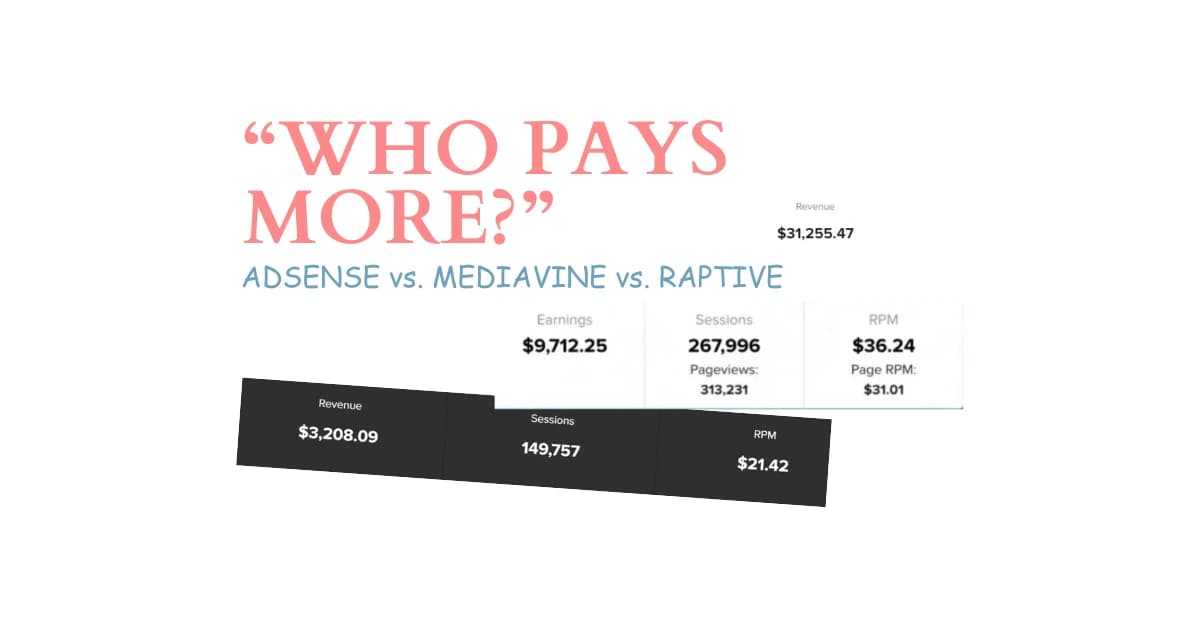
Should you compare ad networks using other bloggers’ RPM screenshots?
You can use other publishers’ experiences to understand what may be possible, but don’t treat their numbers as a guarantee of your own earnings.
A reported RPM doesn’t tell you everything about the website behind it.
The niche, audience location, season, and reporting metric can all be different.
Instead, use your own earnings and traffic data to understand how your website performs over time.
How Pinterest Traffic Affects Ad Revenue
Pinterest can be a valuable source of blog traffic, but getting visitors to your website is only the first step.
The next question is: how much can you earn from those visitors?
The answer depends on the audience you’re attracting and the way you monetize your content.
Audience location can make a big difference
Imagine that two blogs receive a similar number of pageviews from Pinterest.
One receives most of its traffic from countries where advertisers are willing to spend more. The other receives most of its traffic from countries where advertising demand is lower.
Even if their traffic numbers are similar, their advertising revenue may be very different.
This is why I wouldn’t evaluate a Pinterest strategy based only on how many visitors you can generate.
You also need to understand where those visitors come from and how your website turns that attention into income.
The geographic requirements of Raptive and Monumetric illustrate why this matters.
Raptive’s requirements prioritize traffic from the US, UK, Canada, New Zealand, and Australia. Monumetric’s requirements prioritize the US, UK, Canada, and Australia.
These criteria show that audience location can influence whether a website qualifies for a particular network.
What if most of your Pinterest traffic comes from lower-ad-demand countries?
This is where I would think beyond display advertising.
If your audience generates relatively low ad revenue, constantly trying to increase traffic may not be the only way to improve your business.
You can also consider affiliate marketing, digital products, and email marketing.
These approaches let you monetize your content in different ways instead of depending entirely on what advertisers are willing to pay for your readers’ attention.
Why Q4 Is Important for Bloggers
One thing I wouldn’t overlook when planning blog content is seasonality.
The fourth quarter, covering October, November, and December, can be an important period for advertising revenue.
Advertising budgets often increase around shopping events such as Prime Day, Black Friday, and Cyber Monday, which can affect publisher earnings.
But here’s the part that’s easy to miss: you need to plan seasonal content before the season arrives.
If you’re creating Christmas content in December, you may have missed the opportunity to build traffic before the main seasonal period.
Instead, think backward from the dates you want your content to serve.
For example, if you want a Christmas-related article to attract visitors during November and December, your content and Pinterest promotion need to be planned ahead of that period.
This is especially important when Pinterest is part of your traffic strategy because you don’t want to wait until everyone is already searching for seasonal ideas before you start publishing.
My approach to seasonal content planning
Rather than treating Q4 revenue as a nice surprise, I’d include seasonal opportunities in my overall content plan.
- Identify the seasonal topics relevant to your niche.
- Prepare content ahead of the period when you want it to attract traffic.
- Create Pinterest content to support those articles.
- Review which seasonal topics perform well so you can plan more effectively next year.
The goal is to give your content time to attract the right audience before demand peaks.
Should You Switch Ad Networks?
This is an important question because switching networks isn’t always as simple as removing one setup and installing another.
Some networks require exclusivity for programmatic advertising.
Journey by Mediavine and Mediavine’s main program require control over your programmatic advertising, meaning you generally can’t run another conflicting display network alongside them.
This doesn’t mean you have to stop using every other monetization method.
Affiliate links, sponsored posts, and your own products are separate revenue streams and can still form part of your business.
The restriction is specifically about conflicting display advertising arrangements.
Why exclusivity matters
Let’s say you’re already using one network and want to test another to see whether your earnings improve.
Before making a change, you need to understand the exclusivity requirements of your current arrangement and the network you’re considering.
You can’t assume you’ll be able to run both networks simultaneously and compare their performance.
This makes choosing a network an important business decision rather than a casual experiment.
What I would consider before switching
Before making a decision, ask yourself:
- Does my website meet the new network’s eligibility requirements?
- Does my audience geography fit its criteria?
- Am I comfortable with its ad placement expectations?
- Do I understand its exclusivity requirements?
- Am I evaluating the network based on my own traffic and revenue rather than someone else’s RPM?
Answering these questions can help you make a more informed decision about whether a switch is worth considering.
How to Make Money Beyond Display Ads
Here’s the part I think deserves just as much attention as choosing an ad network.
Display ads shouldn’t be the only monetization strategy you build around your blog.
Ads can provide a valuable income stream, but the basic model has a limitation: your earnings are tied to the advertising generated by your traffic.
If you want to double your advertising income at the same RPM, you generally need to double the traffic or otherwise improve the factors that influence your revenue.
As your website grows, that can become increasingly difficult.
That’s why I would treat display advertising as one part of a broader monetization strategy.
1. Affiliate marketing: Earn from recommendations
With display ads, you’re monetizing the attention of your readers.
With affiliate marketing, you’re earning a commission when a reader takes a qualifying action, such as purchasing a product through your affiliate link.
This creates a different way to monetize the same content.
For example, a Pinterest visitor might land on a product comparison article because they’re already researching what to buy.
A useful recommendation within that article can help the reader make a decision while giving you an opportunity to earn affiliate revenue.
Content that naturally supports purchasing decisions includes:
- Product roundups.
- Comparison articles.
- Best-of lists.
- Detailed product reviews.
- Articles targeting readers who are already considering a purchase.
The important part is choosing relevant products and building trust with your audience.
You don’t have to abandon display advertising to use affiliate marketing, either. The exclusivity requirements discussed earlier relate to conflicting display advertising arrangements, not affiliate links.
2. Digital products: Build something you own
Another option is creating your own digital products.
Depending on your niche and audience, these might include:
- Recipe packs.
- Planners.
- Templates.
- Printables.
- Short courses.
Digital products allow you to create something useful for your audience and sell it at a price you set.
You also avoid the inventory and shipping requirements associated with physical products.
One benefit I particularly like about this model is that it doesn’t depend on advertisers deciding how much your audience is worth.
If your Pinterest traffic comes from countries where advertising demand is lower, a genuinely useful product can offer another way to generate revenue.
Of course, success still depends on whether the product meets your audience’s needs and whether people are willing to buy it.
But it gives you another opportunity to monetize your expertise instead of relying exclusively on display ads.
3. Email marketing: Turn one-time visitors into a repeat audience
Pinterest can introduce new readers to your website, but what happens after they leave?
Without another way to reach them, you may need to attract them again through new visits.
That’s where an email list becomes valuable.
You can encourage readers to subscribe by offering a useful free resource, such as a guide, checklist, or other helpful download.
Once someone joins your list, you have a way to communicate with them again and share relevant content, affiliate recommendations, or your own products.
Think of these revenue streams this way:
- Display ads monetize traffic.
- Affiliate marketing monetizes purchase intent.
- Digital products monetize the value you create.
- Email marketing helps you build an ongoing relationship with your audience.
Together, these approaches can create a more flexible business than relying on display advertising alone.
Which Ad Network Should You Choose for Pinterest Traffic?
Now let’s bring everything together.
There isn’t one ad network that’s automatically best for every Pinterest blogger. The right choice depends on your current traffic, audience location, content, and eligibility.
Here’s how I’d approach the decision.
If you’re just starting your blog
Consider Google AdSense.
It has no minimum traffic requirement, making it a potential starting point while you work on creating useful content and growing your Pinterest traffic.
If you have 1,000 sessions in 30 days
Evaluate Journey by Mediavine.
Its entry requirement makes it a potential next step for growing blogs. Just remember to review its Grow plugin and programmatic advertising exclusivity requirements.
If you have 10,000–80,000 monthly pageviews
Consider Monumetric Propel.
Review the $99 setup fee, qualifying audience locations, and expected ad placements before deciding whether it fits your website.
If you have at least 25,000 monthly pageviews
Put Raptive on your shortlist.
Its minimum threshold is lower than the previous 100,000-pageview requirement covered in this guide. However, you’ll still need to meet its audience geography, domain age, and content criteria.
If you’re already generating $5,000 in annual ad revenue
Evaluate Mediavine’s main program.
Its revenue-based eligibility requirement means you should focus on your actual advertising earnings, not just your monthly session count.
If you’re already using Ezoic
Review your existing status before making changes.
Under the requirements covered here, new applicants face a 250,000 monthly active user threshold, while certain existing publishers retain grandfathered status subject to the stated conditions.
Don’t remove an existing integration without understanding how that might affect your eligibility.
Ultimately, the goal isn’t to choose the network with the most impressive reputation or the biggest RPM screenshot.
It’s to choose an option that fits your blog today while building a business that can continue growing tomorrow.
Frequently Asked Questions
Which ad network is best for Pinterest traffic?
The best option depends on your website’s traffic, audience geography, content, and eligibility.
AdSense may be a starting point for a new blog. Journey can be worth evaluating at 1,000 sessions in 30 days, while Monumetric and Raptive become relevant at their respective pageview thresholds. Mediavine’s main program uses an annual ad revenue requirement under the criteria discussed in this guide.
Can I use Mediavine and another display ad network at the same time?
Journey by Mediavine and Mediavine’s main program require exclusivity for programmatic advertising. You should review their requirements before attempting to run another display network alongside them.
Affiliate links, sponsored posts, and your own products are different monetization methods and are not covered by the same display advertising restriction.
Is AdSense good for a new Pinterest blog?
AdSense can be a reasonable starting point because it has no minimum traffic requirement. It gives you an opportunity to begin monetizing while building your audience, although other networks may be worth considering as your blog grows.
How much can I earn from Pinterest traffic with display ads?
There isn’t a single amount that applies to every website. Your earnings depend on factors such as your niche, audience location, seasonality, ad placements, and engagement.
Two blogs with similar traffic can generate different advertising revenue.
Is Raptive better than Monumetric?
Neither network is automatically better for every blog.
Raptive’s minimum requirement covered here is 25,000 monthly pageviews, while Monumetric Propel covers 10,000–80,000 monthly pageviews. Their audience geography and other eligibility requirements also differ.
Compare the criteria against your website rather than choosing based on traffic thresholds alone.
Should I focus on display ads or affiliate marketing?
I wouldn’t limit a blog to just one monetization method if there are other relevant opportunities.
Display ads monetize traffic, while affiliate marketing can earn commissions from purchases. Your own digital products and email marketing can provide additional ways to generate revenue and build relationships with readers.
The right mix depends on your niche and audience.
Why does audience location matter so much for ad revenue?
Advertisers don’t place the same value on every audience, which can affect both RPM and eligibility for certain networks.
That’s why some ad networks specify the percentage of traffic they expect from particular countries. If your audience doesn’t meet those criteria, another monetization method may be worth exploring alongside display ads.
Final Thoughts
Choosing the best ad network for your Pinterest blog isn’t just about finding the one that pays the most.
It’s about understanding where your website is right now, knowing what each network requires, and choosing a monetization strategy that makes sense for your audience.
If you’re just starting, AdSense can be a place to begin. As your traffic grows, Journey, Monumetric, and Raptive may become options worth evaluating. If you’re already generating substantial ad revenue, Mediavine’s main program deserves consideration. And if you’re already using Ezoic, make sure you understand the implications of its current eligibility requirements before making any changes.
But here’s what I really want you to remember: don’t spend all your energy optimizing display ads while ignoring the other ways your blog can make money.
Keep growing your Pinterest traffic, create useful content, explore relevant affiliate opportunities, build an email list, and consider developing a digital product that solves a real problem for your readers.
Your ad network matters. But the bigger opportunity is building a blog that doesn’t depend on a single income stream.
That’s the difference between simply getting traffic and building a business around it.